Add the Complete Weight
Include every mounted fixture, T-bar, adapter, clamp and other component.

A 30 kg load rating does not automatically mean that you can distribute any combination of fixtures anywhere on a stand. Centre of gravity, height, crossbar, lateral offset, footprint, floor conditions and external forces all affect stability. A well-planned lighting stand keeps the combined load as central as possible over its base and is used only within the conditions documented by the manufacturer.
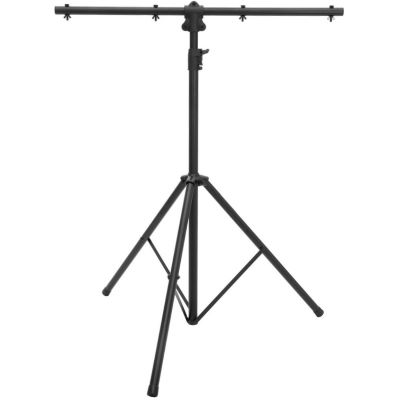
Maximum load capacity is only the starting point. The stand must also suit the type of load, required working height, footprint and actual environment.
Include every mounted fixture, T-bar, adapter, clamp and other component.
Determine whether the equipment is distributed evenly around the stand axis or positioned significantly to one side.
Operate only within the intended height range and engage every required locking device completely.
Use a level, sufficiently load-bearing and suitably slip-resistant surface.
Audience areas, walkways, accidental impacts, wind and other lateral forces belong in the assessment.
Manufacturer ratings apply under defined conditions. The archived K&M 24620 documentation, for example, explicitly specifies a 20 kg central load. Always read the instructions for the exact stand you use.
The stated load capacity describes the maximum intended load within the conditions defined by the manufacturer. It is not an additional safety reserve and must not be exceeded.
The combined centre of gravity of the installed equipment should remain as close as possible to the centre column and within the intended footprint.
Moving weight sideways creates an additional tipping moment. EUROLITE specifies the DTV-10 at 14 kg for central loading, but only 10 kg for asymmetrical loading.
The stand, T-bar, adapters and attachment components have their own limits. The complete setup must remain within every relevant component rating.
| Example | Manufacturer Rating | Height Range | Important Detail |
|---|---|---|---|
| EUROLITE LCK-1 | 30 kg | 140–250 cm | 4 T-bar points, max. 7.5 kg each |
| EUROLITE DTV-10 | 14 kg central / 10 kg asymmetric | 114–250 cm | 16 mm Mini TV spigot |
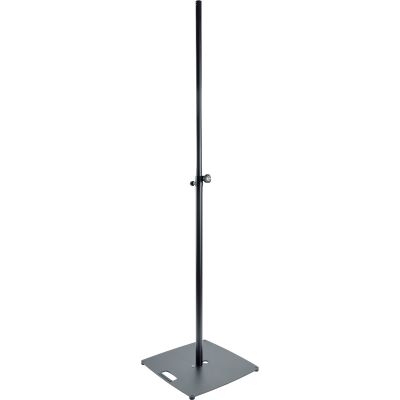
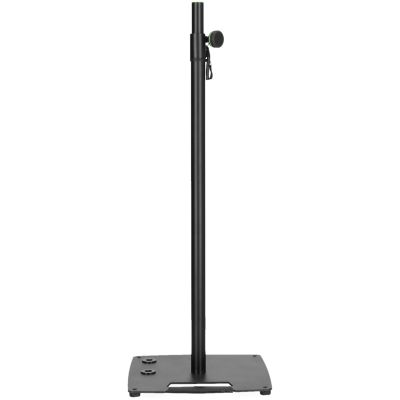
| K&M 24651 | 30 kg | 142–242 cm | Heavy 550 × 550 mm steel base |
| Hercules LS-700B | 45 kg | 164–350 cm | Crank-operated lighting stand |
A nominal load is not a planning target. Keep useful reserve instead of designing every setup to sit permanently at the maximum documented value. The exact manufacturer conditions remain decisive.
Imagine a vertical line running downward from the combined centre of gravity of all installed equipment. The more centrally that line remains within the stand footprint, the more favourable the basic situation is against tipping.
Put a heavy moving head at the far left of a T-bar and only a small PAR at the right and the combined centre of gravity shifts sideways. A stand rated for 30 kg centrally does not automatically support the same total mass in this strongly asymmetric layout.

The farther a load is positioned away from the centre column, the greater the resulting tipping moment can become. Boom, T-bar and specialist stands therefore require their own manufacturer specifications.
Only when the exact configuration remains within the permitted mounting and load conditions. With a conventional T-bar, an even distribution is normally the more favourable plan.
Remember: the stand does not simply “carry 30 kg anywhere”. The documented construction carries a defined load under defined conditions.
A T-bar distributes several fixtures across a wider area. That is useful, but it also creates additional lever arms. The crossbar therefore has its own mounting points and load limits.
Where the system permits it, place heavier fixtures closer to the stand axis and lighter fixtures farther out.
Two similarly weighted fixtures mounted symmetrically create a more favourable arrangement than the same total mass located entirely on one side.
On the EUROLITE LCK-1, the four designated T-bar mounting points are each rated for a maximum of 7.5 kg.
Crossbars, clamps, TV spigots and adapters belong to the mounted construction and must be suitable for their intended use.
20 kg T-bar + 30 kg stand does not equal 30 kg of usable lighting payload. If the crossbar permits only 20 kg, this lower limit applies to the load mounted on it. The conditions of the stand itself apply in addition.
The higher the equipment is positioned, the higher its centre of gravity becomes. Lateral forces can therefore generate a greater tipping moment.
Fully engage locking bolts, pins and all intended clamping elements. A friction clamp does not replace an existing mechanical safety stage.
Crank-operated systems can raise heavier assemblies more controllably. The crank mechanism does not increase the permissible rating beyond the documented value.
Maximum height is not a target. Extend a stand only as far as necessary to achieve the required lighting position. Unnecessary additional height provides no advantage for stability.
| Construction | Main Strength | Typical Application | Check Carefully |
|---|---|---|---|
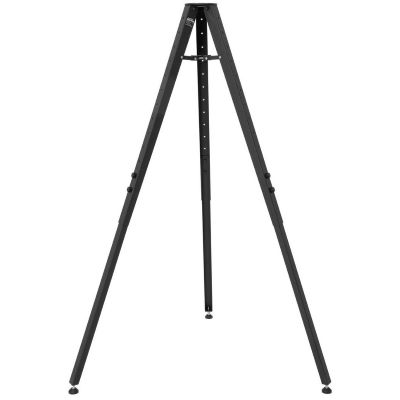
| Tripod | Light and mobile | DJ, band, small stage | Full leg spread and footprint |
| Base-Plate Stand | Small floor area | Club, stage, installation | High stand self-weight |
| Wind-Up / Crank | Controlled lifting | Heavier lighting equipment | Mechanism and locking system |
| Floor Stand | Very low centre of gravity | Uplighting and floor PARs | Not a substitute for a high stand |
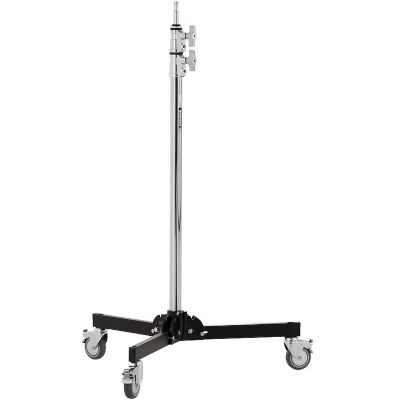
| Roller Stand | Mobile within a studio | Film, photo and production | Lock the wheels during use |
A lighting fixture presents an area to the wind. Wind therefore creates a lateral force which, acting at the height of a stand, can generate considerable leverage. Such lateral forces are not automatically included in a simple vertical load rating.
An indoor stand does not become a suitable outdoor solution simply because its vertical kilogram rating appears high enough.
Use ballast, weights or guying only when they are part of a suitable manufacturer configuration or competent professional planning.
Temporary event technology must consider the expected environmental conditions and appropriate measures or stop criteria.
For larger outdoor lighting structures: a professionally planned truss or stage-construction system may be more appropriate than several tall individual stands.
Put tripod legs in their intended operating position and check the locks. Do not use a half-open “space-saving” position.
Attach fixtures and crossbars securely while the working height is low instead of improvising overhead.
Check total mass, balance left and right and secure every intended mounting screw or clamp.
Position the extensions one after another and fully engage all existing pins, locking bolts or mechanical safety devices.
Recheck stability, cable pull, walkways, fixture mounting and locking devices before the event begins.
Professional event use: structures must safely withstand and transfer the static and dynamic loads expected during their intended use. Equipment over people and more complex professional installations are subject to additional requirements and should be planned and checked by appropriately qualified personnel.
These examples cover very different load classes and construction types. Use the product data as a starting point and check the current manufacturer instructions before every actual setup.
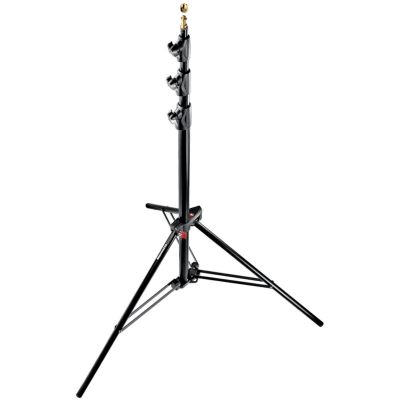
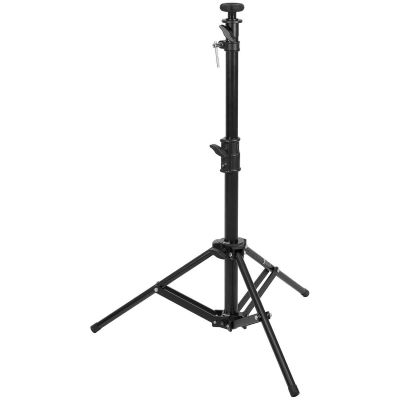
Portable solutions with very different load capacities and working heights.
Base-plate, follow-spot and heavy steel stands for applications where higher stand weight or greater nominal capacity is useful.
Useful when heavier assemblies need to be raised to working height in a controlled way.
High stands, integrated crossbars and boom designs require especially careful attention to load distribution and leverage.
The accessory has its own rating. A stronger stand does not override a lower crossbar limit.
Manufacturers use different mounts, locking mechanisms and load specifications. For safety-relevant combinations, do not select stands and accessories solely because the tube diameters appear to match.
Do not automatically transfer a nominal central rating to a strongly asymmetric setup.
Reducing the intended footprint changes the designed stability of the system.
Even when the stand has a higher rating, the crossbar still has its own limit.
Overly tight lateral cable routes can introduce additional forces into the stand.
A high vertical load rating does not specify permissible lateral forces outdoors.
Pins and locking bolts are not optional when they form part of the intended construction.
It is the manufacturer's stated maximum load under the intended operating conditions. Whether 30 kg is permitted at every height, load distribution or lateral-force condition can only be determined from the documentation for the exact product.
Yes. Crossbars, adapters, clamps and other mounted components belong in the total assessment. In addition, the T-bar itself must remain within its own permitted rating.
Only if the stand, T-bar, mounting points and manufacturer conditions explicitly permit that configuration. Symmetrical loading is generally more favourable than one-sided loading, but it does not replace checking the product data.
This creates a larger lever arm around the centre axis. Check the permitted individual mounting-point load and total rating explicitly. Heavy fixtures are generally easier to balance nearer the stand axis.
Greater stand weight can contribute to stability, but it is not proof of safety by itself. Footprint, centre of gravity, height, construction and external forces remain decisive.
Only within the operating conditions specified by the manufacturer. In practice, use only the height actually required for the lighting position.
Heavier loads can be raised to working height in a more controlled manner. The crank does not automatically increase permissible load capacity; the rating of the exact stand remains decisive.
Only when the intended use and expected environmental conditions are covered by the product documentation or appropriate professional planning. Wind is especially important because it creates additional lateral forces.
Do not improvise ballast. Ballast or guying should only be used when it forms part of an intended manufacturer configuration or competent professional planning.
Only when the manufacturer and the adapters used provide for that application. Products such as the K&M 24651 and Gravity LS 431 C B are explicitly designed as combined lighting/speaker solutions.
When many fixtures need to be distributed over a greater width, greater heights are required or a more extensive professional stage structure is planned, a properly designed truss system may be the more suitable solution.
Select compact fixtures according to weight, beam angle and intended mounting method.
Consider fixture mass, centre of gravity and the movement of the mounted equipment particularly carefully.
For longer lighting runs, greater heights and more extensive stage constructions.
Suitable securing and event-technology safety accessories for compatible applications.
Add every component belonging to the setup and then check the permitted values for the stand, crossbar and mounting equipment. Distribute fixtures as evenly as possible, avoid unnecessary lateral offset and use only the height actually required. Set the stand up fully on a level, load-bearing surface and consider lateral forces. Wind and one-sided loading in particular can make an apparently sufficient kilogram rating irrelevant.
Stage construction, lighting technology, truss systems, PA systems, mixers, microphones, DJ technology, recording and musical instruments: the central Musikhaus Korn guide leads to further buying advice, comparisons and complete setup solutions.