Musikhaus Keks
Welcome!
Our cookies offer you a fast, relaxed and full-featured shopping experience. Some are necessary to operate the website and its functions. Others help us to improve our services. If you agree to this, simply consent to the use of cookies for preferences, statistics and marketing by clicking on "OK". Alternatively, you can deactivate individual cookies under "Customise cookies" or all cookies, except those required for the function of our website, under "Reject all".
Musikhaus Korn Buying Guide

Understanding Reeds & Reed Strengths: Find the Right Reed for Clarinet and Saxophone

Strength 1.5, 2, 2.5 or 3.5? A stronger reed is not automatically better. What matters is how the reed, mouthpiece, embouchure and instrument work together. This guide explains how to recognise a reed that is too soft or too hard, how different cuts behave and which strength can make sense for your individual setup.

Clarinet & Saxophone Reed Strengths Explained Clearly Natural & Synthetic Reeds
The Most Important Rule First

Which Reed Strength Suits Me?

In simplified terms, the number printed on a reed describes its resistance or flexibility. Within the same reed series, a higher number is normally stronger.

A strength 3 reed therefore generally requires more force or air control than a strength 2 reed from exactly the same series.

This does not mean: beginners play strength 2 and professionals play strength 4.

A suitable reed must match the mouthpiece facing, embouchure and desired playing feel. An experienced jazz saxophonist may prefer a relatively soft reed on an open mouthpiece, while a different setup with a more closed facing may work better with a stronger reed.

Quick Test

Start with a Balanced Amount of Resistance

  • The note speaks without excessive effort.
  • Soft notes remain controllable.
  • High notes do not immediately become thin.
  • Strong playing does not cause the reed to close up.
  • Embouchure and jaw remain relaxed.
Understand Resistance Correctly

Soft or Hard Reed – What Actually Changes?

Softer

Easier Response

A softer reed usually requires less air pressure before it begins to respond.

This can feel comfortable when starting out and often makes soft playing and flexible tonal changes easier.

If the reed is too soft, however, the sound can become unstable or very bright, and powerful playing may become difficult to control.

Balanced

Enough Resistance without Fighting

The right reed provides noticeable but easily controllable resistance.

Tone onset, articulation and register changes work reliably without forcing the player to fight against the reed.

Stronger

More Resistance & Stability

A stronger reed can provide more resistance, stability and dynamic headroom.

If it is too hard for the mouthpiece or the player, the instrument may sound airy or forced and response becomes unnecessarily difficult.

When changing strength: move in small steps and compare strengths within the same reed series whenever possible.
The Instrument Gives You Clues

How Can You Tell if a Reed Is Too Soft or Too Hard?

Observation Possible Cause Next Test
The note speaks only with a lot of effort Reed may be too strong Test half a strength softer
The sound feels airy and exhausting Overall resistance may be too high Check the reed and mouthpiece together
Powerful notes collapse or close up Reed may be too soft Test the next stronger version
Pitch fluctuates strongly Setup may be too flexible Compare reed, embouchure and mouthpiece
One individual reed plays poorly Natural cane may be uneven or damaged Try another reed of the same strength
Not every problem is caused by reed strength: a damaged reed, incorrect reed position, an instrument that leaks, an unsuitable mouthpiece facing or an unfavourable embouchure can create similar symptoms.
Mouthpiece and Reed Form One System

Why Does Reed Strength Depend on Tip Opening?

On clarinet and saxophone, the reed vibrates against the facing of the mouthpiece.

The more open the tip of the mouthpiece is, the further the reed is able to move.

For that reason, more open mouthpieces are frequently combined with slightly softer reeds.

With a more closed facing, a stronger reed can provide the desired amount of resistance.

The exact combination still depends on the individual mouthpiece model, facing geometry and the player's embouchure.

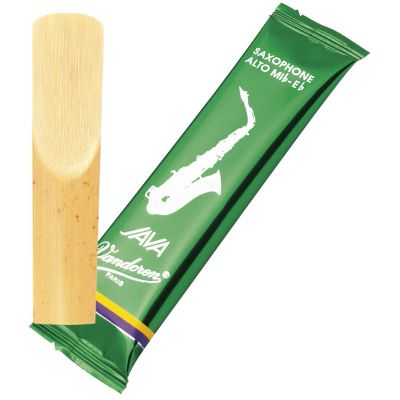
Vandoren Java 2.5 alto saxophone natural cane reed in green packaging
Vandoren Java 2.5 for alto saxophone – an alternative cut that can feel different from a Classic reed carrying the same strength number.
Do Not Compare the Number Alone

Why Reeds with the Same Strength Can Feel Completely Different

The tip, heart, heel and overall material distribution are designed differently from one series to another.

A strength 2.5 reed from one series can therefore react noticeably differently from a 2.5 reed with another cut.

Versatile Reference

Traditional Cut

Versatile reed series are a useful starting point for lessons, classical music, ensembles and different mouthpieces.

Players who want to understand how their setup reacts can begin with a familiar reference series before moving to more specialised cuts.

Modern Styles

Jazz & Pop Cuts

Series such as Java or ZZ react differently from traditional reeds and can offer more immediacy, flexibility or projection.

As a result, the strength required for the same player may shift when changing reed series.

Bb Clarinet

German or French Cut

With Bb clarinets, the instrument and mouthpiece system must also be considered.

Vandoren White Master, for example, is designed for German clarinets, while the Classic series uses a French cut.

Every Instrument Needs Its Own Reed Size

Which Reed Categories Are Available?

Clarinet

Bb, Eb & Bass Clarinet

Different clarinet sizes require corresponding reed dimensions and cuts. Bb-, Eb- and bass-clarinet reeds are not interchangeable.

Saxophone

Alto Saxophone

Alto saxophone offers a broad selection ranging from traditional classical reeds to jazz-oriented reed series.

Saxophone

Soprano & Tenor

Soprano and tenor saxophones both use their own reed dimensions. The reeds cannot be exchanged between the two instrument sizes.

Low Saxophone Register

Baritone Saxophone

Baritone saxophones require correspondingly large reeds for their low register.

Synthetic options can also be particularly interesting in this instrument family.

Oboe and bassoon: these instruments use double reeds. Their construction, strength and preparation differ fundamentally from the single reeds used on clarinet and saxophone and should be selected specifically for the instrument.
Natural Cane or Synthetic

What Are the Advantages of Synthetic Reeds?

Traditional reeds are usually made from Arundo donax cane.

Natural cane responds in a lively way and remains the traditional standard for clarinet and saxophone.

Because it is a natural material, individual reeds from the same box can react differently.

Synthetic reeds are designed to provide more repeatable characteristics. Depending on the product, they may require no pre-moistening and react less strongly to humidity.

Their playing feel is different, however, so the appropriate strength should still be tested rather than simply copied from a natural-cane setup.

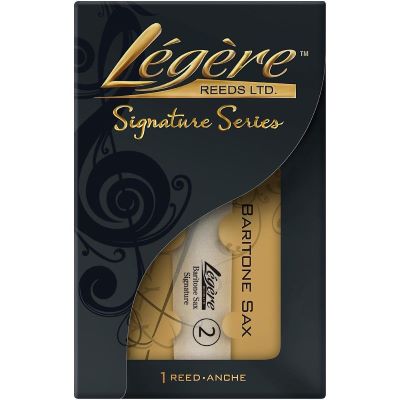
Legere Signature synthetic baritone saxophone reed strength 2.25
Legere Signature 2.25 for baritone saxophone – a synthetic alternative designed for repeatable response and longer service life.
More Consistency & Longer Reed Life

Prepare and Store Reeds Correctly

Before Playing

Moisten & Align

Lightly moisten natural-cane reeds before playing.

Position the reed straight on the mouthpiece and avoid touching the delicate reed tip with your fingers.

After Playing

Remove & Dry

Remove the reed from the mouthpiece and eliminate excess moisture.

Do not leave a natural reed permanently mounted on the mouthpiece.

Rotating several reeds can make everyday practice more reliable.

Replacement

When Is a New Reed Necessary?

Cracks, frayed tips, permanent warping or noticeably poorer response are typical reasons to replace a reed.

Practical routine: keep several well-playing reeds in rotation. This gives you immediate backup if one becomes damaged and makes changes in response easier to identify.
Sorted by Instrument & Strength

32 Suitable Reeds to Compare

Use these reeds as a starting point. When testing a new cut or series, it is usually useful to try individual reeds first before buying a larger package.

All Reeds
10 Reeds

Bb Clarinet: French & German Cuts

10 Reeds

Alto Saxophone: Classic, Java & Filed Red

8 Reeds

Tenor Saxophone: Java, Classic & Steuer

Reeds & Accessories by Brand

Suitable Manufacturer Worlds at Musikhaus Korn

Vandoren

Classic, White Master, Java, V16, V12, ZZ and further reed series for clarinet and saxophone.

GEWA

Ligatures, care products, bags and further wind-instrument accessories.

Frequently Asked Questions from Lessons & Practice

Answers about Reeds & Reed Strengths

Which Reed Strength Is Suitable for Beginners?
Softer to medium reeds are often used initially so that the note responds without excessive resistance. The correct number still depends on the mouthpiece. There is no universal beginner strength that works for every instrument and setup.
Is Reed Strength 3 Better than Strength 2?
No. Strength 3 is simply stronger or less flexible than strength 2 within the same reed series. The correct strength is the one that allows your mouthpiece to work in a controlled and relaxed way.
When Should I Move to a Stronger Reed?
If your current reed becomes unstable during powerful playing, offers too little resistance or gives you insufficient control in the upper registers, testing the next stronger strength can be worthwhile.
Why Does a New Reed of the Same Strength Feel Harder?
Natural cane is not perfectly identical. Reed series and manufacturers also use different cuts. Compare several reeds rather than judging an entire strength from a single example.
Do I Need a Softer Reed with an Open Mouthpiece?
Frequently, yes. More open mouthpiece facings are often combined with softer reeds, while more closed facings can work well with stronger reeds. The exact mouthpiece model remains decisive.
Are Clarinet and Saxophone Reeds Interchangeable?
No. Soprano, alto, tenor and baritone saxophones as well as the different clarinet types each require appropriately sized reeds.
What Is the Difference between German and French Clarinet Cuts?
The reeds are designed around different mouthpiece and clarinet traditions. Players using a German clarinet should deliberately match the reed cut to the corresponding mouthpiece system.
How Long Does a Reed Last?
This depends on how frequently you play, care, material and embouchure. Replace a reed when it becomes damaged or when response and control noticeably deteriorate.
Does a Saxophone Reed Need to Be Wet before Playing?
Natural-cane reeds are lightly moistened before playing. Depending on the manufacturer, synthetic reeds can be ready to play without prior moistening.
Should I Use Several Reeds at the Same Time?
A small rotation is useful. Several broken-in reeds give you immediate backup if one becomes damaged and make it easier to compare changes in an individual reed.
Resistance Is Not a Performance Level

Understanding Reeds & Reed Strengths

The right reed strength is not an award for your playing level. It is one component of a functioning setup.

Mouthpiece facing, reed series, cut and embouchure must work together. When looking for a different reed, it is therefore useful to compare two neighbouring strengths within a familiar reed series first.

Clarinet players must additionally consider German and French reed cuts. Saxophonists can compare traditional, jazz-oriented and synthetic reeds.

The decisive result is always practical: the tone should speak easily, the reed should provide enough resistance for control and the instrument should respond across all registers without unnecessary effort.

More Buying Advice & Practical Knowledge

Combine Wind Instruments and Accessories Correctly

Further guidance covering instruments, accessories, recording, DJ equipment and event technology can be found in the central Musikhaus Korn guide.