Trumpet & Cornet
Rim diameter, cup depth and rim shape influence comfort, tonal character and the perceived resistance.
Cornet and trumpet each require the appropriate shank.

A mouthpiece changes more than the sound. It influences response, resistance, comfort, articulation and the overall playing feel. On trumpet, trombone and horn, the lips make direct contact with the rim and cup. On clarinet and saxophone, the mouthpiece, reed and ligature work together as one system.
Mouthpieces can look similar, but they are not freely interchangeable. Instrument type, shank, method of tone production and construction all have to match.
Rim diameter, cup depth and rim shape influence comfort, tonal character and the perceived resistance.
Cornet and trumpet each require the appropriate shank.
Larger mouthpieces expose a larger area of the lips to vibration.
With trombones, the correct small or large shank must also be considered.
Flugelhorn mouthpieces use their own shank systems. With French horn mouthpieces, funnel shape, rim and internal contour play a particularly important role.
Here, the playable system is created only when the mouthpiece, reed and ligature work together.
Tip opening and reed strength therefore need to be matched.
The mouthpiece forms the direct connection between player and instrument. Even small differences alter how much air flows, how freely the lips or reed can vibrate and how much resistance the player feels.
No single measurement should be considered in isolation. A deeper cup, for example, can behave differently when the throat, backbore and rim are also changed.
The same applies to saxophone: a more open mouthpiece can work very well with a softer reed but may become unnecessarily demanding when paired with a reed that is too hard.
Such labels are useful when comparing mouthpieces within one manufacturer or model family. They should not be interpreted as globally identical measurements across all brands.
When changing manufacturer, compare the actual rim, cup and bore specifications as well as the real playing feel.
With brass instruments, the player's lips create the vibration. The mouthpiece shapes and transfers that energy into the instrument.
A smaller diameter limits the freely vibrating lip area more strongly and can feel compact.
A larger diameter provides more room for the lips and can support a broader sound, but it also requires suitable control.
Shallower cups tend towards a more direct and brighter character and can support the upper register.
Deeper cups tend to support a fuller, darker basic character and lower registers.
The rim determines the immediate physical feel on the lips.
Wider versions distribute pressure differently, while sharper inner edges can offer very defined response. Anatomy and embouchure are also decisive.
Throat and backbore strongly influence perceived airflow resistance.
Larger or more open internal dimensions can feel freer but generally require more air and control.
With clarinet and saxophone, a single reed vibrates against the facing of the mouthpiece. Mouthpiece and reed therefore cannot be evaluated meaningfully in isolation.
The tip opening describes the distance between the reed tip and the tip of the mouthpiece.
A more open mouthpiece often offers greater flexibility but can require a softer reed in many combinations. A more closed facing can work well with a stronger reed.
The facing length determines where the reed begins to separate from the mouthpiece.
On saxophone mouthpieces, chamber, baffle and internal contour also influence projection, resistance and tonal character.
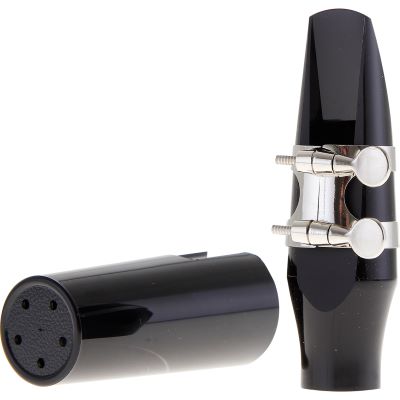
The following effects are tendencies, not guarantees. The complete setup and the individual player always influence the result.
| Feature | Typical Tendency | What to Check during Testing |
|---|---|---|
| Larger Brass Rim Diameter | More lip area and a broader playing feel | Check endurance and control |
| Shallower Cup | Brighter, more direct and supportive of the upper register | Listen to tonal body in the middle register |
| Deeper Cup | Warmer and fuller | Compare airflow demand and response |
| More Open Sax / Clarinet Tip | More flexibility and potentially more resistance | Test with a softer reed |
| More Closed Tip | More compact and controlled feel | A stronger reed may work well |
| Wider Rim | Different pressure distribution on the lips | Simulate a longer practice session |
Are you looking for more comfort, a different response, stronger projection or another tonal character? Without a clear objective, comparison quickly becomes arbitrary.
With saxophone and clarinet, begin with the same reed. This makes it easier to hear what the mouthpiece itself changes.
Test long tones, articulation, soft passages, high and low registers and typical pieces from your own repertoire.
A mouthpiece that sounds spectacular on the first note can become tiring during a longer playing session. Comfort and consistency matter as well.
The current selection covers trumpet, trombone, baritone, flugelhorn, cornet, signal horns and alto saxophone and adds reeds, a ligature and cleaning products for the woodwind setup.





Mouthpieces should be cleaned regularly. On brass mouthpieces, deposits inside the internal channel can be removed with a suitable brush.
Woodwind mouthpieces should be separated from the reed and ligature after playing and cleaned according to the material requirements of the individual mouthpiece.
A stuck brass mouthpiece should be removed with suitable equipment.
Pliers can damage both the mouthpiece shank and the instrument's leadpipe or receiver. If you are unsure, professional repair is the safer solution.
Manufacturers use different systems. Actual dimensions and playing feel matter more than the number alone.
A specialist mouthpiece does not replace a developed embouchure and can make other registers less suitable.
A new tip opening without an appropriately matched reed strength can make an otherwise good mouthpiece feel unplayable.
Trombone, flugelhorn and related brass instruments in particular can use different receivers.
Replacing the mouthpiece, reed and ligature simultaneously makes an objective comparison difficult.
One impressive first note says little about endurance, control and playing feel during a longer rehearsal.
The right mouthpiece is always a combination of instrument, player and musical task.
On trumpet, trombone and other brass instruments, rim, cup, throat, backbore and shank determine the playing feel.
With saxophone and clarinet, tip opening, facing length, ligature and especially the correct reed also become part of the setup.
If you want to change mouthpiece, first define the concrete goal and then alter only a small number of parameters at a time. This makes it possible to judge reliably whether response, comfort, endurance and tone really suit your playing better.
Further guidance covering wind instruments, musical instruments, studio equipment, DJ technology and event equipment can be found in the central Musikhaus Korn guide world.