5A – Start Versatile
A medium format for lessons, pop, rock, funk, studio work and many other applications.

The right drumstick should feel like a natural extension of your hands. Diameter, length, weight, balance, wood and tip influence control, rebound, volume and cymbal sound. This guide explains what designations such as 5A, 7A, 5B and 2B mean and helps you choose sticks that suit your hand size, music style, drum kit and playing technique.
The numbers are only a starting point. Two sticks from the same size family can feel different because of length, taper, wood and centre of gravity. Nevertheless, the four common formats provide very useful initial orientation.
A medium format for lessons, pop, rock, funk, studio work and many other applications.
A slimmer format for quiet grooves, jazz, lessons, fast patterns and sensitive dynamics.
A thicker format for rock, pop, louder rehearsals and drummers who find a 5A too slim in the hand.
A significantly more substantial format for strong backbeats, training and a deliberately heavy stick feel.
As a rough guide within the traditional naming system, a lower number generally indicates a more substantial stick. A 2B is therefore considerably thicker than a 7A.
However, the designation is not a worldwide millimetre-standardised measurement.
Within comparable traditional sizes, a B model is often more substantial than an A version.
A 5B will therefore normally feel fuller in the hand than a 5A.
A Vic Firth American Classic 5A is approximately 406 mm long with a diameter of around 14.4 mm.
A Rohema Classic 5A is approximately 405 mm long with a diameter of around 14.5 mm. Small differences in taper and centre of gravity can already be noticeable while playing.
Dimensions vary between manufacturers and series. The table therefore describes typical characteristics of the size families rather than a binding standard.
| Size | Feel | Dynamics | Typical Application | Good Starting Point For |
|---|---|---|---|---|
| 7A | Slim and light | Fine control | Jazz, pop, acoustic music, lessons | Smaller hands and quieter playing |
| 5A | Balanced | Highly versatile | Pop, rock, funk, studio, lessons | Most beginners |
| 5B | Thicker and fuller | More mass | Rock, pop, funk, stage | Drummers who prefer a fuller grip |
| 2B | Very substantial | Lots of mass and resistance | Powerful playing, training, loud applications | Large hands or deliberately heavy sticks |
Hickory is used for a large number of professional and traditional drumsticks.
It combines durability with comfortable vibration behaviour and is therefore widely used in 5A, 5B, 7A and 2B models.
Maple can feel lighter at comparable dimensions.
This makes maple sticks interesting for fast movement, long practice sessions or drummers who want a larger stick without as much overall mass.
Manufacturers such as Rohema also offer hornbeam, Hornwood and other alternatives.
These options allow the feel to be refined further according to density, surface and personal preference.
The tip contacts drumheads and cymbals on almost every stroke. Its material and shape therefore have a particularly noticeable influence on ride and hi-hat articulation.
A traditional wood tip provides a natural cymbal sound and is standard on many drumsticks.
Shapes such as Tear Drop, Barrel or Acorn alter the contact area and therefore the articulation.
Nylon often creates a clearer, brighter and more consistent ping on cymbals.
This can be useful for ride patterns, rehearsals with a loud band or particular studio sounds. The basic weight and balance of the stick remain just as important as the tip material.

5A is one of the most versatile starting points and allows wood type, surface and tip to be compared without immediately changing to a completely different stick size.
Classic 5A format made from maple with a wooden tip.
Approximately 405 mm long with a diameter of around 14.5 mm.
Hickory stick with a nylon tip for clearly defined cymbal articulation.
Unlacquered alternative with a natural surface and hornbeam construction.
Unlacquered hickory for a direct, natural wooden grip.
Approximately 406 mm long, made from hickory with a tear-drop wooden tip.
Lightweight maple format for fast, controlled patterns.
Approximately 395 mm long with a slim diameter of around 13.8 mm.
Hickory with a tear-drop tip for light and defined playing.
Slim hickory stick with a bright, clearly articulating nylon tip.
If 5A feels too delicate or you want more mass for snare, toms and cymbals, 5B and 2B are the logical comparison sizes.
Strong standard size for rehearsal, stage and powerful grooves.
Hickory stick for powerful grooves, rock and louder applications.
Approximately 405 mm long and 15.2 mm in diameter with an unlacquered finish.
Traditional lacquered hickory stick in a fuller 5B format.
Approximately 422 mm long with a substantial diameter and plenty of mass.
Thick hickory stick with a nylon tip for clear cymbal articulation.
Approximately 415 mm long with a substantial 16 mm diameter.
Substantial 2B format with an unlacquered natural surface.
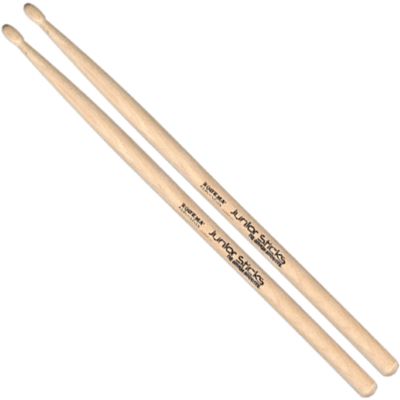
A normal adult stick can be unnecessarily long and heavy for smaller hands.
Special junior sticks reduce length and diameter without giving up the familiar shape of a real drumstick.
Rohema Junior sticks, for example, are approximately 330 mm long and around 13 mm in diameter. Models of approximately 365 mm are available for somewhat larger beginners.
The decisive point is that the child can hold the stick loosely and that the wrist and fingers do not constantly have to work against excessive mass.
For quiet sessions, jazz, acoustic music and special sound colours, changing to another type of playing tool can be worthwhile.
Bundled plastic rods for controlled, lower-volume playing with a softer and more diffuse attack than a solid drumstick.
A warmer, quieter alternative for acoustic sessions and controlled accompaniment.
Metal bristles for traditional sweep techniques and classic jazz-brush articulation.
Nylon fibres provide an alternative articulation for brushes and quieter playing.
5A works perfectly well for controlled rock playing. If you want more mass and more substantial rimshots, compare 5B or dedicated rock sticks.
7A and specialised jazz sticks support delicate ride patterns and lower volume levels.
Traditional brush playing additionally requires suitable jazz brushes in the stick bag.
5A provides plenty of dynamics while remaining fast enough for ghost notes.
7A can suit lighter productions, while 5B works well for more powerful arrangements.
A comfortable weight is important on electronic drums too.
Do not use heavily damaged wooden tips on mesh heads, as sharp splinters can put unnecessary stress on the surface.
A longer taper can create a more flexible impression with the balance feeling further towards the rear.
A shorter taper shifts more mass forwards and can feel more powerful.
Two sticks with very similar dimensions can feel noticeably different when their centre of gravity changes.
The right balance should make rebound and dynamic control easier rather than forcing you to fight the stick.
Lacquered sticks feel smoother, while unlacquered models provide a more direct natural wood feel.
Special grip coatings can be useful for players with sweaty hands. The best option depends strongly on personal preference.
Spare sticks directly beside the drum set are particularly important live if a stick falls or breaks during a song.
Rudiments and stick control can be practised independently of the drum kit in a focused and comparatively quiet way.
Push-on tips can reduce the direct attack during certain practice situations.
Timpani, mallet instruments, gongs and other percussion instruments require their own dedicated mallet types.
Manufacturers interpret traditional sizes differently. Comparing several brands therefore helps reveal how length, diameter, taper, wood and balance affect the feel even within the same 5A, 5B, 7A or 2B class.



Affordable maple 5A, 5B and 7A sticks for lessons, rehearsal and everyday playing.
Hickory, hornbeam, natural finishes, junior sticks, brushes, rods and specialist percussion tools.
American Classic and Nova series covering traditional wood tips, nylon tips and numerous standard and specialist sizes.
Metal does not automatically require 2B and jazz does not necessarily require 7A.
Hand size, technique and desired dynamics are at least as important.
A heavier stick can make powerful accents easier, but it does not replace controlled technique.
Playing loudly should not mean playing with permanent muscular tension.
Spare sticks should be within reach in the rehearsal room and on stage.
Wood is a wear material and can break during intensive use.
Compare several pairs directly. The Musikhaus Korn team can help you choose stick size, material, tip and specialist sticks for acoustic drums, e-drums, lessons, stage use or quiet acoustic sessions.
Choosing the right drumsticks means considering size, weight, balance and material together. 5A is a versatile starting point, 7A feels slimmer and lighter, while 5B offers more grip volume. 2B is intended for drummers who deliberately want a very substantial format.
Wood, surface, taper and the stick tip also influence playing feel. Hickory is a widely used all-round material, while maple can feel lighter at a comparable size. Nylon tips often provide clearer cymbal articulation, whereas wood tips deliver a traditional, natural cymbal sound.
Junior sticks, rock sticks and specialist models extend the traditional size families. Brushes and rods provide additional options for quiet music and special sound colours. It is therefore worth comparing several models in practice: the right stick should feel relaxed in your hand, provide controllable rebound and support your personal drum sound.
From drum sets, cymbals and drumheads to instruments, studio equipment, DJ gear and event technology: further Musikhaus Korn guides help with selection, comparison and building the right setup.