The Shoulder Remains Relaxed
If the left shoulder has to be raised to hold the violin or reach the neck, either the instrument size or the combination of chin rest and shoulder rest is not yet right.

The right violin size determines whether a child or adult beginner can reach the fingerboard comfortably and control the bow properly. A violin should therefore not be bought on the assumption that the player will simply “grow into it”. Arm reach, hand size, shoulder position and a practical fitting test are what really matter.
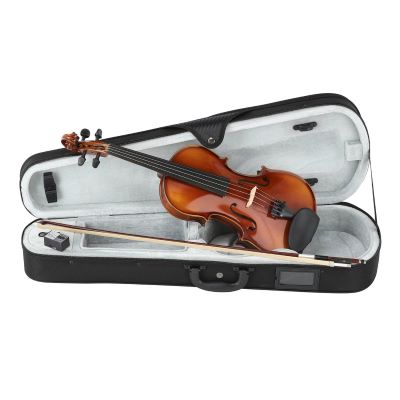
Place the violin under the chin just as you would when playing. Then extend the player's left arm along the neck towards the scroll. If the hand can comfortably reach and wrap around the scroll or pegbox without the shoulder and elbow having to be completely extended, the violin is within a sensible size range.
During normal playing, the left elbow should still have some freedom of movement. If the player has to stretch the arm fully, raise the shoulder or rotate the upper body, the violin is too large.
If the instrument is clearly too small, on the other hand, the fingering hand becomes unnecessarily cramped and the usable bow path becomes shorter. Especially with children, it is therefore worth checking the violin size regularly.
Fractional sizes such as 1/2 or 3/4 do not mean that the complete instrument is mathematically exactly half or three quarters the size of a full-size violin. They are established violin size classes.
| Size | Approx. Body Length | Typical Use | Matching Accessories |
|---|---|---|---|
| 1/16 | Smaller than 1/8 | Very small children, specialist case | Specially matched bow and shoulder rest |
| 1/8 | approx. 25 cm | Young children beginning lessons | 1/8 bow and small shoulder rest |
| 1/4 | approx. 28 cm | Young violin students | 1/4 bow and suitable strings |
| 1/2 | approx. 30.5 cm | Children with increasing reach | 1/2 bow and 1/2 string set |
| 3/4 | approx. 33 cm | Older children and teenagers | 3/4 bow; shoulder rests often cover 3/4–1/2 |
| 4/4 | approx. 35.5 cm | Older teenagers and adults | 4/4 accessories and full-scale strings |
Important: age and body-height charts are only a guide. Two children of the same age can require different violin sizes because their arm lengths and hand sizes may differ.
The complete playing posture is important when checking violin size. Shoulder, elbow, fingers, head position and bow movement all need to work together naturally.
If the left shoulder has to be raised to hold the violin or reach the neck, either the instrument size or the combination of chin rest and shoulder rest is not yet right.
The arm needs freedom of movement while fingering. If it is already fully extended when the player reaches the scroll, the instrument is clearly too large.
The left hand should be able to move around the neck without tension. Small hands benefit from a shorter scale length and closer finger spacing.
A smaller violin requires a correspondingly shorter bow. Instrument and bow should therefore be treated as one unit whenever the player changes violin size.
The violin should not have to be held by excessive clamping. A suitable size makes a stable position possible without unnecessary pressure.
Smaller players in particular need to be able to reach the tip of the bow without pulling the shoulder or upper body forwards.
A position may appear acceptable during a very short test yet become tiring after a few minutes. Do not judge the fit using only a single reach test.
For children, the current ergonomic fit should determine the size. Buying a larger violin simply because the child may grow soon makes fingering and bowing more difficult precisely during the phase in which clean movement patterns are being learned.
Depending on their build, young students may begin with a 1/8 or 1/4 violin. Later they generally move through 1/2 and 3/4. The change to a 4/4 violin should take place only when the full-size instrument can be reached comfortably.
Complete violin outfits are particularly practical because the bow and case already match the size of the instrument. A shoulder rest should still be selected separately to suit both the player's body and the violin.
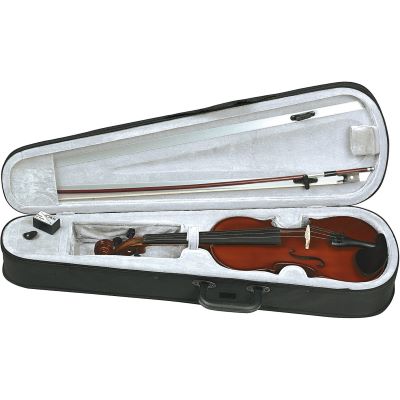
A full-size violin is the appropriate starting point for the large majority of adult players. Teenagers also generally change to 4/4 once their reach is sufficient.
A well-fitting 4/4 violin provides the widest selection of instruments, bows, strings and accessories and is the standard choice for most adult beginners.
Yes. For particularly small adults, short arms or specific ergonomic requirements, a smaller violin can feel more comfortable. Musically, a 3/4 violin is not simply a “children's toy”.
If you are unsure, the playing posture should be checked with a teacher or in a specialist music shop.
Do not move automatically to a larger size according to age. Check the player's reach again and make sure the next instrument can already be played without overextension.
If the child can now reach far beyond the scroll of the current violin, it is worth comparing it with the next size.
Do not change automatically. The larger violin must already feel comfortable and must not require the player to overextend the arm.
When changing from 1/2 to 3/4, a correspondingly sized bow will normally be required as well.
Shoulder rest, case, strings and, where relevant, bridge or chin rest may also be size-dependent and should be checked at the same time.
A 1/2 violin is played with a suitable 1/2 bow. A bow that is too long makes it more difficult for smaller players to control the bow at the tip.
Many shoulder rests cover two sizes, such as 4/4–3/4 or 3/4–1/2. Check the stated size range and available adjustment before buying.
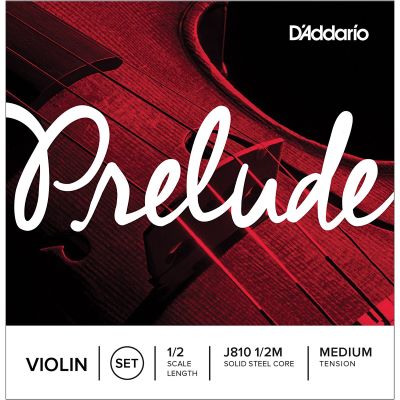
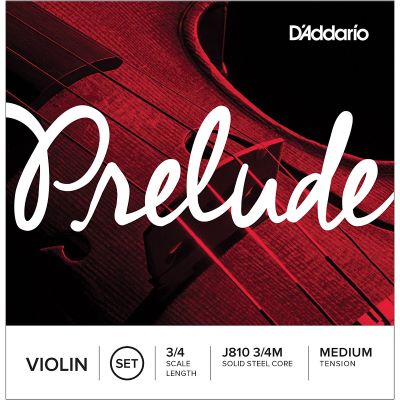
String sets are matched to instrument size and scale length. A 3/4 string set therefore belongs on a 3/4 violin rather than simply being fitted to a full-size instrument.
Cases and violin bridges are also offered for particular sizes. A new bridge in particular should be professionally fitted to the individual instrument.
This selection includes current student and training instruments as well as size-dependent accessories. Each size level can therefore be considered as a complete setup rather than only as an individual violin.
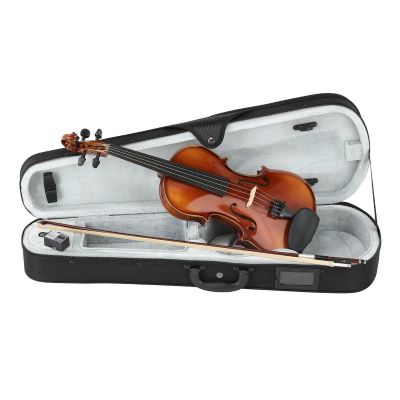
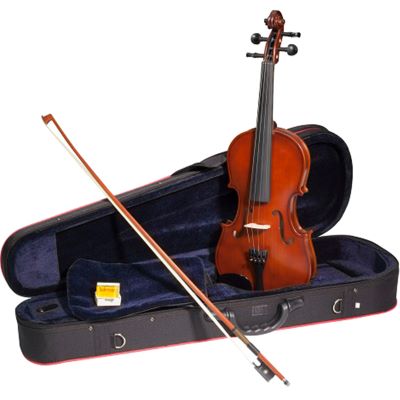
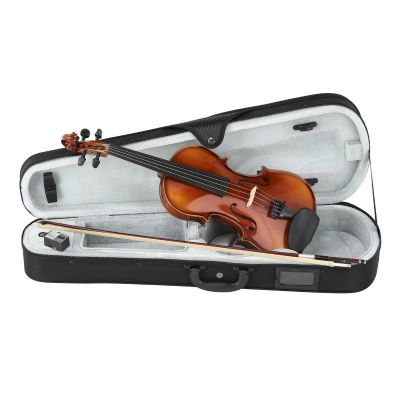
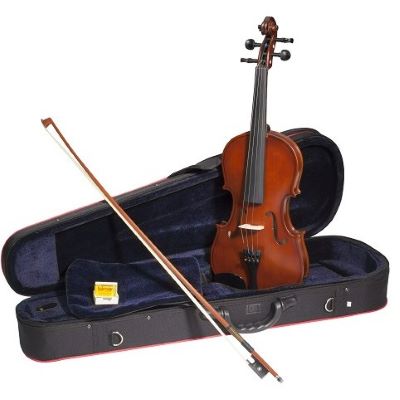
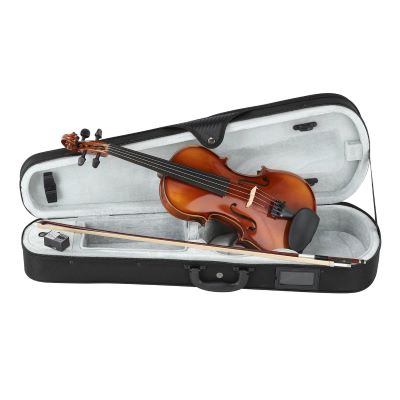
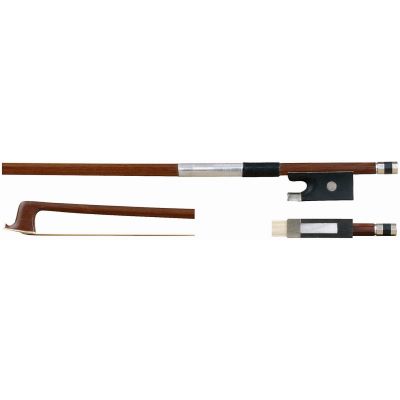
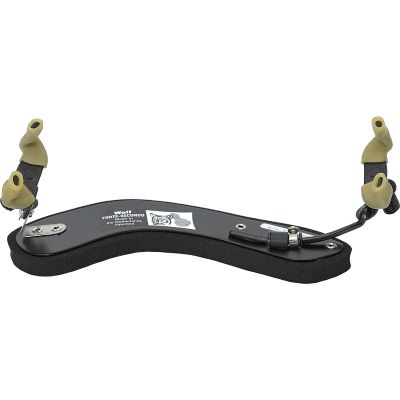
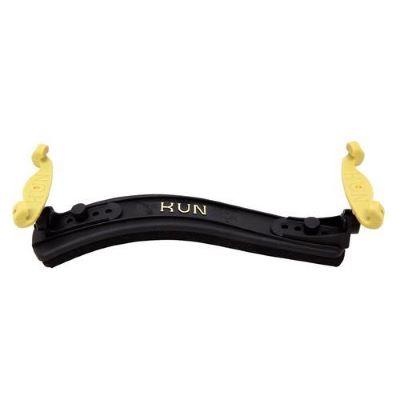
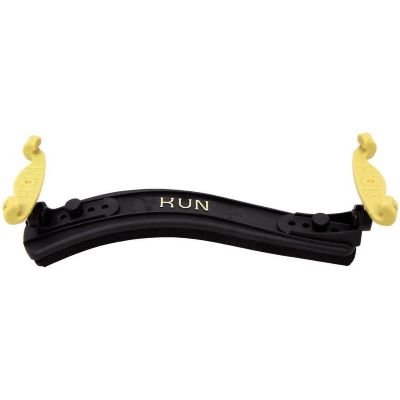




Student violins, bows, cases, rosin and further accessories for bowed string instruments.
Violin outfits for different stages of musical development and several instrument sizes.
Violin strings for several scale lengths as well as accessories for bowed string instruments.
Stands and holders for safely placing or storing instruments during practice, rehearsals and performances.
An instrument that is too large forces the player into an unfavourable posture during precisely the important first phase of learning.
Age reveals relatively little about actual arm and hand length. The violin should always be checked directly against the player.
Bow, shoulder rest, strings and case may also depend on violin size and should therefore be checked together with the new instrument.
Place the violin under the chin and extend the left arm towards the scroll. The hand should comfortably reach or wrap around the pegbox without the arm having to be fully extended.
Most adults play a 4/4 violin. For very small players or people with short arms, a smaller size may sometimes be ergonomically more comfortable.
This depends on arm length and hand size. Common children's sizes are 1/8, 1/4, 1/2 and 3/4. Age should only be used as a rough guide.
No. The fractional figures are traditional size designations. A 1/2 violin has a body considerably larger than the mathematical half of a full-size violin.
The 3/4 violin is larger. The usual sequence is 1/8, 1/4, 1/2, 3/4 and finally 4/4.
When the current violin has clearly become too small and the next size can be played comfortably without overextension. Ideally, the change should be discussed with the child's teacher.
Only if the 4/4 size genuinely fits ergonomically. In most cases, 3/4 is the more sensible intermediate step because the difference between 1/2 and full size is significant.
As a rule, yes. A correctly sized bow supports appropriate reach, balance and control. When changing instrument size, the bow size should therefore also be checked.
That depends on the model. Many shoulder rests cover two neighbouring sizes, for example 3/4 and 1/2 or 4/4 and 3/4.
Yes. String sets are available for different scale lengths. The size stated for the string set should match the violin.
No. A smaller student violin is primarily adapted ergonomically. Workmanship, setup and overall quality determine how well the instrument plays regardless of its size.
The correct violin size can be determined most reliably by checking the instrument directly against the player. Arm reach, hand size and a relaxed shoulder position are more informative than a rigid table based only on age. During their training, children often progress from 1/8 or 1/4 through 1/2 and 3/4 before finally moving to the full-size 4/4 violin.
Whenever the violin size changes, the complete setup should be checked as well. Bow, shoulder rest, strings and case all need to suit the new instrument. A ready-to-play complete outfit can make this step easier because the violin and bow are already supplied in the same size class.
Once the violin fits ergonomically, beginners can concentrate on what really matters: relaxed posture, clean bowing, intonation and enjoying regular playing.
Find further guidance on string instruments, wind instruments, drums, keyboards, studio equipment, DJ technology and event equipment in the central Musikhaus Korn guide.