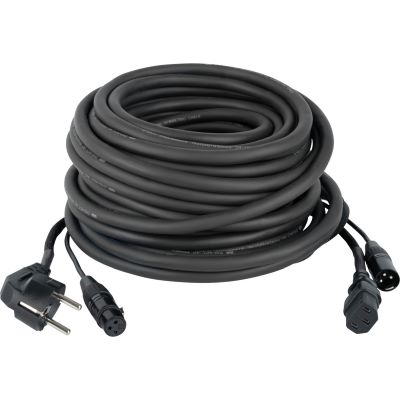
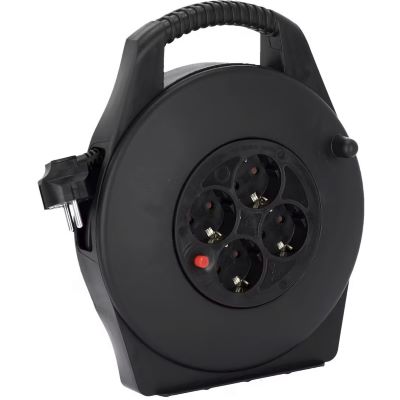
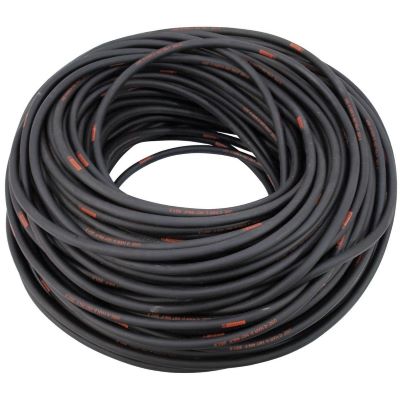
0.75 to 1.0 mm²
These cross-sections are found on certain IEC and equipment power leads. The decisive factor is the intended connected load of the specific device, not a general rule for event extensions.

Is 3×1.5 mm² sufficient for 20 metres? When does 3×2.5 mm² become useful? Why may a cable reel carry considerably less electrical load when it remains wound up? With power cables, conductor cross-section and cable length are directly related. As the cable run becomes longer, resistance increases and so does voltage drop. At the same time, current-carrying capacity, circuit protection, installation conditions and automatic disconnection requirements must suit the complete circuit.
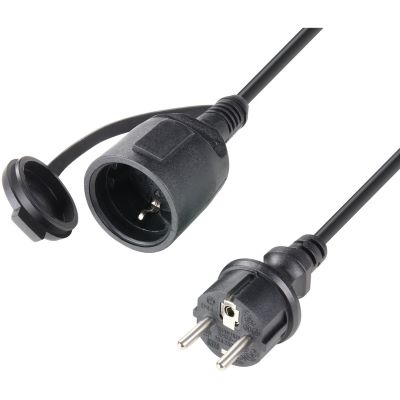
Do not select a conductor cross-section solely from the plug. Load, protection, installation conditions, environment and complete cable length must all be considered.
A conductor cross-section cannot be selected from the connector alone. The cable must suit the connected load, protective device, installation method, environment and length. For professional electrical circuits, binding dimensioning must be carried out by an appropriately qualified electrician.
These cross-sections are found on certain IEC and equipment power leads. The decisive factor is the intended connected load of the specific device, not a general rule for event extensions.
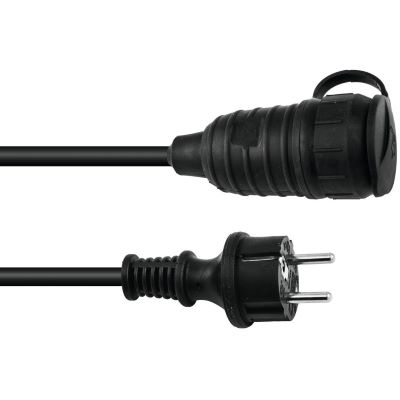
In the current Musikhaus Korn power-cable range, 3×1.5 mm² is by far the most common conductor size. It is used, among other things, for robust H07RN-F extension cables.
A larger copper cross-section means lower conductor resistance. This becomes increasingly relevant with higher loads and longer cable runs.
CEE16, CEE32 and larger supplies require suitable multi-core cables. Their cross-section is professionally dimensioned according to current, installation conditions, length and protective device.
Important: a Schuko plug marked 16 A does not automatically mean that every connected cable may be continuously operated at 16 A in every length, installation method and environment.
The first number indicates the number of conductors and the second their nominal conductor cross-section. 3×1.5 therefore means three conductors, each with a nominal cross-section of 1.5 mm². In the notation 3G1.5, the letter “G” indicates that a green/yellow protective conductor is included.
Particularly common for device-specific power leads. Do not confuse these cables with universal stage extension cables intended for substantially higher loads.
Frequently found on ready-made Schuko and event cables. Robust H07RN-F versions are particularly relevant for mobile setups.
At the same cable length, 2.5 mm² has lower conductor resistance than 1.5 mm². This reduces voltage drop and power loss in the cable.
Every copper conductor has electrical resistance. The longer the cable and the higher the current flowing through it, the greater the voltage drop across the cable. A larger conductor cross-section counteracts this effect.
For a single-phase 230 V copper cable, an approximate orientation can be calculated using:
ΔU ≈ 2 × length × current × specific resistance / conductor cross-section
The factor 2 accounts for the outgoing and return conductor. Different relationships apply to three-phase circuits.
Current-carrying capacity, conductor temperature, installation method, grouping, circuit protection, loop impedance and the required automatic disconnection in the event of a fault must also be checked. Voltage drop in all upstream cables also counts.
Three percent is used as an orientation value for voltage drop in various planning contexts. It is not a general permission to dimension one individual event extension cable exactly up to this value. The complete current path and the specific protection concept remain decisive.
Safety note: the simplified formula illustrates the relationship between length, current and cross-section. It does not replace professional electrical dimensioning or verification of the complete circuit.
The following values are simplified calculation examples for copper, 230 V, 16 A and a power factor close to 1. They show only how conductor cross-section and cable length influence ohmic voltage drop. They are not approval for a specific electrical installation.
| One-Way Length | 3×1.5 mm² | 3×2.5 mm² | Interpretation |
|---|---|---|---|
| 5 m | approx. 0.8% | approx. 0.5% | Short run |
| 10 m | approx. 1.6% | approx. 1.0% | Difference already visible |
| 20 m | approx. 3.2% | approx. 1.9% | Cross-section becomes increasingly important |
| 25 m | approx. 4.1% | approx. 2.4% | Plan high loads carefully |
| 50 m | approx. 8.1% | approx. 4.9% | Do not dimension using a simple rule of thumb |
Why does this table deliberately look demanding? It assumes the full 16 A. A 100 W LED PAR naturally draws considerably less current than a large fog machine or another high-power load. Real electrical load and total cable length therefore always belong together.
H07RN-F is a robust, flexible rubber-sheathed cable suitable for more demanding mobile applications. The current Musikhaus Korn range includes several ready-made Schuko extensions using this type of cable.
Electrical current produces heat losses in the conductor. When many metres of cable are wound closely together on a reel, this heat cannot dissipate as effectively. The permitted electrical load can therefore be considerably lower while the cable remains wound.
Useful compact reach for a stage, rehearsal room or small event setup.
Practical medium range. At higher loads, unwind the cable completely and follow the specific product information.
Large reach means that voltage drop and thermal load require particularly careful consideration.
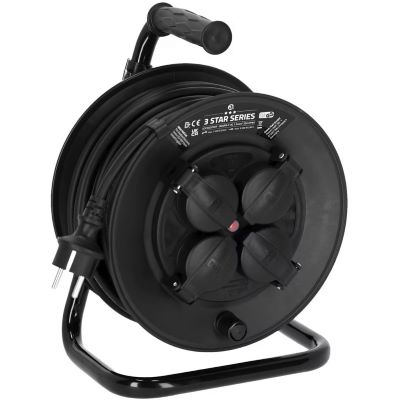
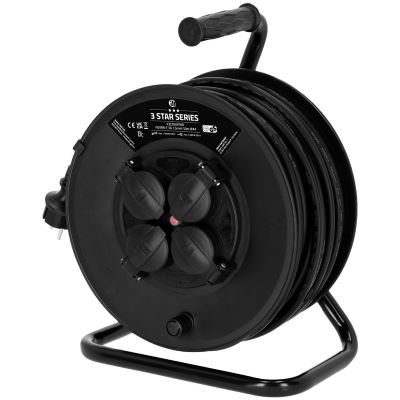
Concrete product example: for the Adam Hall 3 STAR 25 m and 50 m cable reels with 3×1.5 mm² conductors, Musikhaus Korn currently specifies a maximum load of 3,200 W when fully unwound and only 1,100 W when wound. The information for your specific cable reel always remains decisive.
Red five-pole CEE connections carry three line conductors, a neutral conductor and a protective conductor. Common cable types therefore have five cores. The actual conductor cross-section required depends, among other things, on rated current, cable length, installation method, environment, upstream protective device and required disconnection conditions.
Common on smaller mobile stage distribution systems. Select the cable cross-section for the specific electrical installation, not simply because the connector is red and rated CEE16.
Common on more powerful PA and lighting distribution systems. Longer supply cables make voltage drop and disconnection conditions increasingly important.
Typical territory for professional event power distribution. Planning, connection, measurement and verification belong in the hands of a qualified electrician.
Electrical safety, current-carrying capacity, voltage drop and protective measures determine the choice.
A larger conductor cross-section also reduces cable losses here, but the calculation concerns the output of a power amplifier, not a 230 V mains installation.
For digital data lines, impedance, shielding and the specified transmission distance are important. A larger power-conductor cross-section is not the decisive criterion.
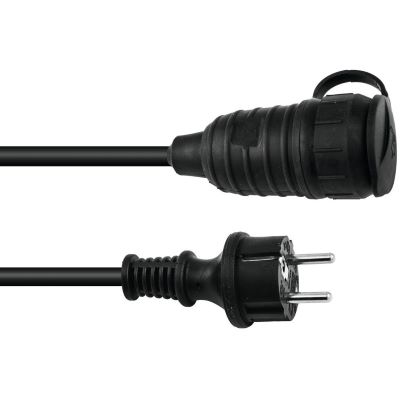
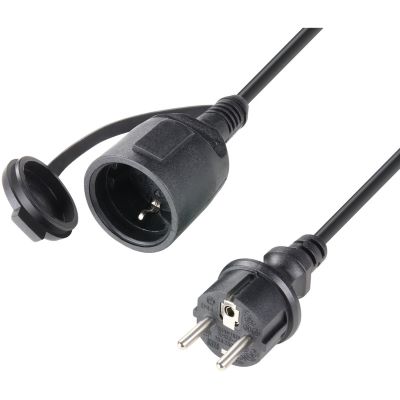
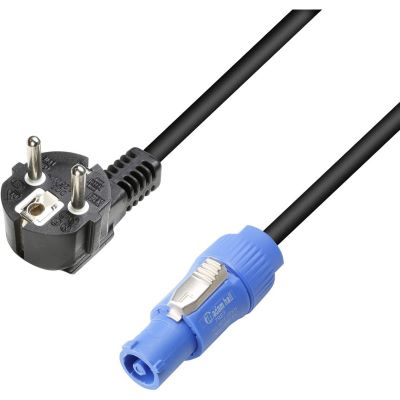
The selection includes short equipment leads, robust H07RN-F extensions, Powercon and Power Twist connections, longer combined power/signal cables, cable reels and bulk cable.
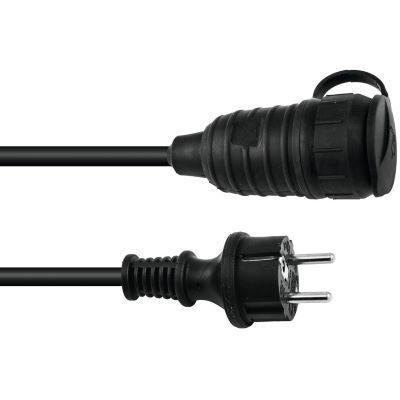
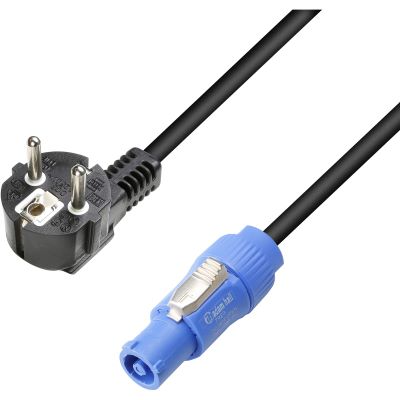
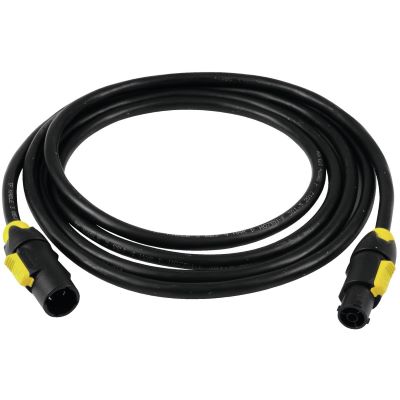
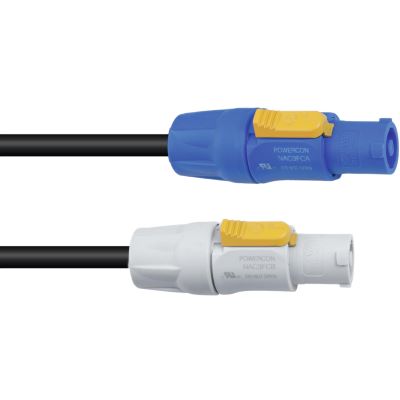
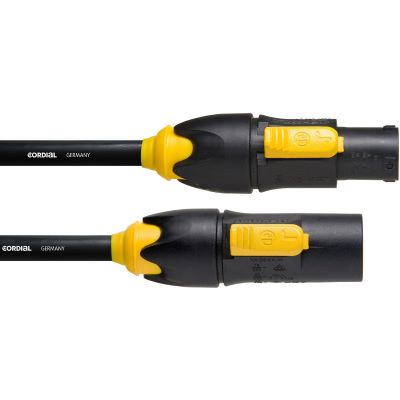
Bulk cable is intended for appropriate professional cable assembly and specialised cable solutions.
Bulk cable is not a ready-made mains cable. Cable assembly, connector selection and the required electrical testing must be carried out professionally.




Schuko or Powercon alone says nothing about the conductor cross-section required for the specific application.
For voltage drop and disconnection conditions, the complete cable length all the way to the connected load is relevant.
Every additional metre increases conductor resistance and therefore voltage drop.
The permitted electrical load can be dramatically lower while the cable remains wound.
A larger conductor cross-section improves voltage-drop performance but does not replace complete electrical verification.
Plugs, couplers, distributors and their positioning must also be suitable for the environment.
There is no universal maximum length. Current, circuit protection, installation method, environment, voltage drop and disconnection conditions jointly determine the permissible cable run. At high loads, even a comparatively short cable can become electrically relevant.
At the same length, a larger conductor cross-section reduces conductor resistance and therefore voltage drop. Whether 2.5 mm² is actually required or sufficient is determined from the complete electrical circuit.
It means three conductors, each with a nominal cross-section of 1.5 mm². The letter “G” indicates that the cable contains a green/yellow protective conductor.
No. The theoretical value from 230 V × 16 A is not a general approval for every cable. Cable type, conductor cross-section, length, installation conditions, connectors and protective device must all be suitable.
Electrical resistance increases with cable length. Voltage drop and power loss therefore increase as well. A larger conductor cross-section reduces this effect.
A wound cable cannot dissipate heat as effectively. Manufacturers therefore frequently specify a substantially lower maximum electrical load for the wound condition.
Yes. For many professional mobile applications, this robust flexible rubber-sheathed cable is a useful choice. Its actual suitability still depends on the environment and the complete electrical circuit.
Electrically, this creates a correspondingly longer total cable run. Voltage drop and protective conditions must therefore be considered across the entire chain. Additional plug connections are also extra mechanical potential failure points.
The CEE connector alone does not conclusively determine the required conductor cross-section. Current, cable length, installation method, temperature, protective device and disconnection requirements must be assessed together by a qualified professional.
Work on mains cables and connectors must be carried out professionally and subsequently subjected to the required electrical testing. Bulk cable is therefore not simply an unfinished plug-and-play extension cable.
Equipment leads are dimensioned for their intended application and may carry considerably lower currents than a general-purpose Schuko extension. Their design must not simply be transferred to another application.
Plan Schuko, CEE and sub-distribution according to the total connected load and the complete electrical installation.
Protect longer cable routes mechanically across audience and working areas where appropriate.
Choose conductor cross-section and length sensibly between a power amplifier and a passive loudspeaker as well.
Special cable types for appropriate professional individual cable assembly.
3×1.5 mm² is widely used for mobile Schuko and event cables. At the same length, 3×2.5 mm² has lower resistance and therefore reduces voltage drop. Nevertheless, a power cable can never be selected from these two figures alone. Circuit protection, installation conditions, temperature, total cable length and disconnection requirements all form part of correct dimensioning. For mobile applications, robust cable types, suitable connectors and safe cable routes must also be considered.
Power supply, cables, stage construction, lighting, PA systems, mixers, microphones, DJ equipment and recording: the central Musikhaus Korn guide takes you to further buying advice, comparisons and complete setup solutions.