Begin with the Reach
Children often start with a shorter 1/8, 1/4, 1/2 or 3/4 guitar. The decisive question is whether the first fret can be reached without twisting the upper body or fully extending the arm.

1/2, 3/4, 7/8 or 4/4? The right guitar does not depend on age alone. Body height, arm length, hand size, scale length and body shape determine whether the instrument can be held comfortably and played cleanly. This size guide explains traditional fractional sizes as well as compact acoustic, mini and short-scale electric guitars.

A guitar fits when the shoulders remain relaxed, the first frets can be reached without excessive stretching and the body does not force the picking arm unusually high. Age can narrow down the choice, but it should never be the only criterion.
Children often start with a shorter 1/8, 1/4, 1/2 or 3/4 guitar. The decisive question is whether the first fret can be reached without twisting the upper body or fully extending the arm.
Most adults use a 4/4 guitar. Smaller players or anyone looking for a more compact instrument may feel more comfortable with a 7/8 classical guitar, a parlour or travel acoustic guitar or a short-scale electric guitar.
Fractional sizes are especially common for classical guitars. With acoustic and electric guitars, scale length, body width, body depth, weight and balance are often more informative than a simple fraction.
Practical rule: A slightly smaller guitar with a convincing sound and a relaxed playing position is usually a better choice than an instrument that is too large and intended to be “grown into”.
The following values are useful starting points rather than binding standards. Manufacturers may use different scale lengths, body dimensions and neck widths within the same nominal size.
| Guitar Size | Typical Starting Point | Typical Scale Length | What to Check |
|---|---|---|---|
| 1/8 | Very small children and a first musical experience | Approx. 41–46 cm | Very compact format. Check whether the model is suitable for regular lessons, tuning and the intended learning goal. |
| 1/4 | Small children with a short arm and limited reach | Approx. 44–49 cm | Useful for early lessons when a 1/2 guitar still causes excessive stretching. |
| 1/2 | Often around 6–8 years and 115–135 cm tall | Approx. 53–56 cm | A common primary-school size for shorter arms and smaller hands. |
| 3/4 | Often around 8–11 years and 130–150 cm tall | Approx. 58–62 cm | A widely used student size with a manageable reach and a fuller body than smaller models. |
| 7/8 | Teenagers, smaller adults and players seeking comfort | Approx. 62–63 cm | An intermediate size close to full size, often with a body that already feels substantial. |
| 4/4 | Most teenagers and adults | Often approx. 65 cm for classical guitars | The standard full size for lessons, leisure, studio work and the stage. |
Important: There is no universally binding age standard. Neck width, body shape, string action, seated position and the player’s individual proportions can change which size feels best.
The fractions describe size classes. They are not exact mathematical proportions of a 4/4 guitar. Two guitars with the same fraction can therefore have different scale lengths, neck widths and body dimensions.
A 1/8 guitar is intended for very small players and a first encounter with the instrument. Some models are designed more for early musical experience than for long-term tuition, so tuning stability, workmanship and the teacher’s requirements should be checked.
The shorter scale places the frets closer together, while the reduced body is easier to hold. It may be the right choice when a 1/2 guitar still forces the arm or wrist into an uncomfortable position.
The shortened scale reduces wide stretches and can make first chords easier to reach. It is frequently selected for children beginning regular guitar lessons.
A 3/4 guitar combines a fuller sound and more substantial body with a manageable scale length. It is also popular as a compact travel or sofa guitar for adults.
The 7/8 format is suitable for teenagers and smaller adults, but it is not merely a temporary size. Many players choose it permanently because of its comfortable reach and almost full-size sound.
A 4/4 guitar usually offers the standard body, scale length and fingerboard dimensions expected by most teenage and adult players. Choosing full size does not require particularly large hands, but the playing position must still remain relaxed.
Scale length is the vibrating string length between the nut and bridge. A shorter scale places the frets closer together and often produces a softer string feel, but body shape and neck dimensions remain equally important.
Fractional sizes make classical guitars comparatively easy to classify. In addition to the scale length, pay attention to the usually wider neck, the distance between the strings and the depth of the body.
Terms such as parlour, travel, auditorium and dreadnought often reveal more than a fraction. A large dreadnought body raises the picking arm higher, while parlour and travel models usually offer a more compact seated position.
Mini and short-scale electric guitars reduce the distance between the frets. Their weight, balance, body edges, control positions and strap height should also suit the player, especially when the instrument is used standing up.
Do not compare fractions across every guitar type: a 3/4 classical guitar, a travel acoustic guitar and a short-scale electric guitar may all feel compact while differing considerably in body shape, neck width, weight and playing position.
Sit or stand in the normal playing position and perform the following checks. The player should not have to compensate for the instrument by lifting a shoulder, turning the upper body or severely bending the wrist.
The body of the guitar should not push the picking arm so high that one shoulder remains raised while playing.
The fretting hand should reach the first fret without rotating the torso or completely extending the arm.
Place one finger on each of four neighbouring frets. The wrist should remain stable rather than bending sharply to compensate for excessive distance.
A size that initially feels acceptable may still cause tension. Play for several minutes and check the shoulder, neck, forearm and wrist again.
A wide classical neck may feel different from an electric-guitar neck even when both instruments have a similar scale. Compare whether chords and single notes can be formed without squeezing the hand.
An instrument can feel unnecessarily difficult when its strings are too high above the fingerboard. Size and setup should therefore be assessed separately.
A guitar teacher or specialist adviser can identify compensating movements and compare two neighbouring sizes directly with the player.
This selection illustrates how fractional classical guitars, compact acoustics and mini electric guitars address different body sizes and playing situations. Always compare the dimensions and specifications on the individual product page.
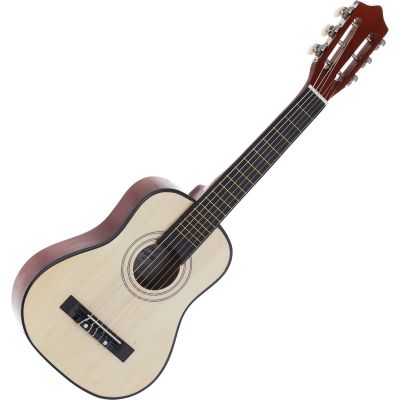
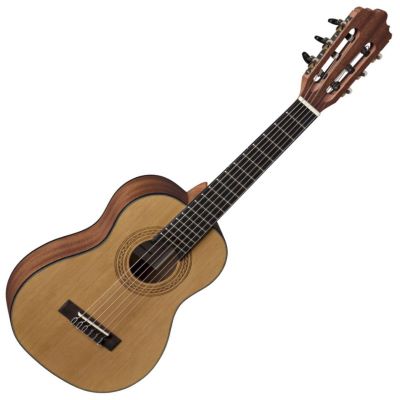
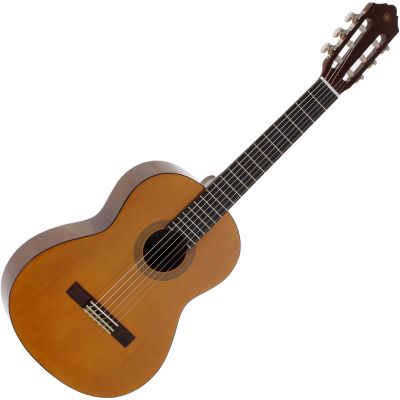
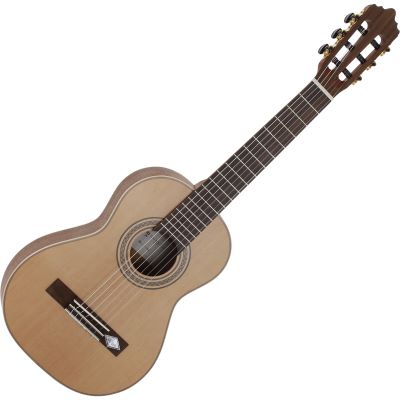

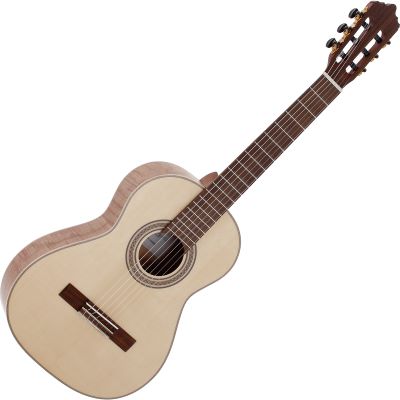
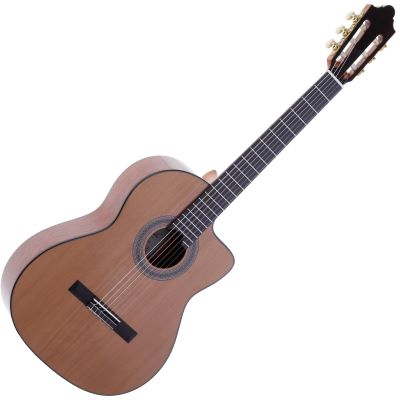
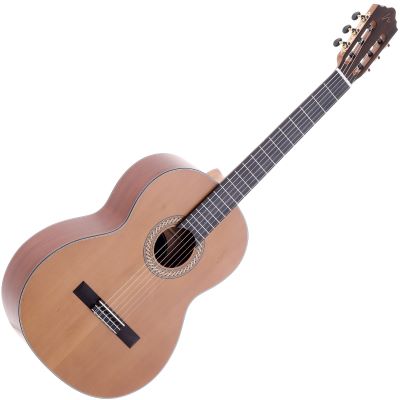
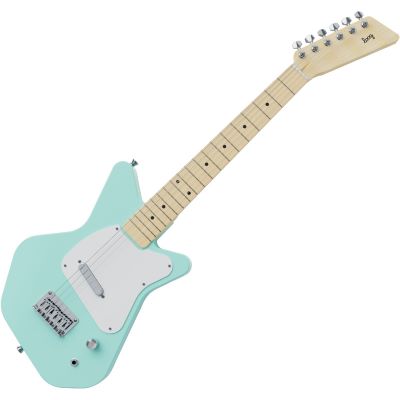
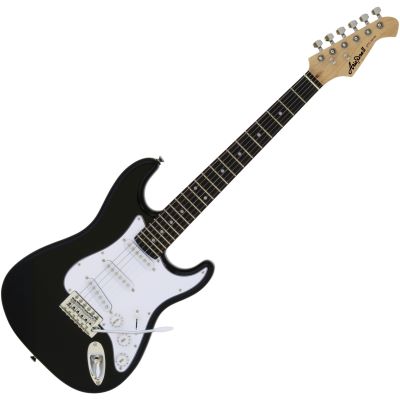
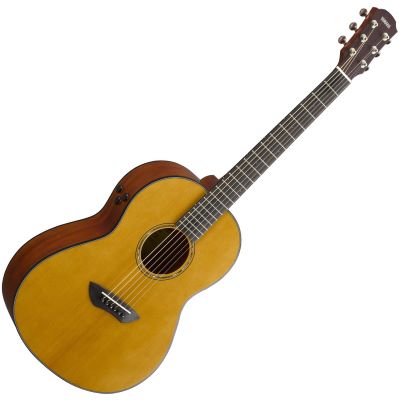
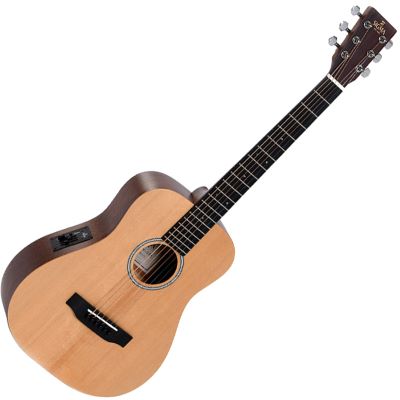
Use these groups to compare neighbouring sizes and different instrument concepts. Product dimensions, scale length, nut width and body shape should still be checked individually.
Intended for a first musical experience, very short arms and players for whom a 1/2 guitar remains clearly too large.
A common starting point for primary-school-age children who need a shorter scale and a more compact body.
These models combine manageable fret spacing with a body and sound that already approach larger classical guitars.
A practical alternative when 4/4 feels unnecessarily large but a 3/4 guitar appears too compact.
Full-size classical guitars offer standard dimensions, but their neck profiles, nut widths and body shapes can still feel noticeably different.
Compact alternatives for younger players, travel, sofa practice and adults who prefer a shorter reach or smaller body.
A “3/4” or “4/4” label alone does not guarantee that a bag, case, stand or string set will fit. Compare the instrument type and its real dimensions.
Compare the guitar’s overall length, lower-bout width, upper-bout width and body depth with the internal dimensions of the bag or case.
Classical, acoustic and electric guitar strings are not interchangeable. String tension also affects the playing feel and tuning stability of short-scale instruments.
A clip-on tuner can be used with almost any guitar size. A stand must securely support the actual body without allowing a small instrument to slip through.
An electric guitar also requires a suitable amplifier, instrument cable and, for standing practice, a correctly adjusted strap.
Compare children’s guitars, student instruments, full-size classical guitars and compact alternatives from specialist manufacturers.








The Musikhaus Korn team can help you compare scale length, neck width, body shape and suitable accessories. For an in-store fitting, bring the future player so the seated position, first-fret reach and hand position can be assessed with the actual instrument.
A 1/2 guitar is often a suitable starting point. A 1/4 model may be more comfortable when the child has particularly short arms. The player should be able to reach the first fret without rotating the upper body or fully extending the arm.
A 3/4 guitar is a common starting point at this height. Depending on arm length and hand size, a 7/8 guitar may already be suitable. Comparing both sizes in the normal playing position is preferable to deciding by height alone.
No. Smaller adults and players who prefer a shorter reach may use a 7/8 guitar permanently. It can offer a nearly full-size sound with a more comfortable scale length and body.
Yes. Adults often choose 3/4 guitars for travel, sofa practice, smaller hands or a particularly compact playing position. The sound and feel differ from a full-size model, but the instrument is not reserved for children.
Body height, arm length, hand size and playing posture are generally more informative than age. Age can be used to narrow down the initial selection, but the final choice should be based on reach and comfort.
A short-scale electric guitar has a shorter vibrating string length between the nut and bridge. The frets are closer together and the strings often feel softer. Weight, body size and balance must nevertheless also suit the player.
No. Taller children may be comfortable with a light full-size electric guitar. A mini model is useful when reach, overall weight or fret spacing make a standard instrument difficult to control.
Consider a larger size when the frets feel cramped, the body has become disproportionately small or the teacher recommends more scale length and resonance. Age alone is not a sufficient reason to change.
No. Guitars with the same fractional size can have different overall lengths, body widths and depths. Compare the instrument’s actual measurements with the bag’s internal dimensions.
Depending on the player, a different guitar type may solve a comfort problem more effectively than simply choosing another fractional size.
Fractional sizes and age recommendations help narrow down the choice, but they do not make the final decision. The right guitar allows relaxed shoulders, comfortable access to the first fret and repeated playing without unnecessary tension. For classical guitars, compare sizes from 1/8 to 4/4. For acoustic and electric guitars, also consider scale length, body shape and weight. Children do not need to grow into an instrument that is too large, and adults do not have to choose 4/4 when a smaller model feels better.