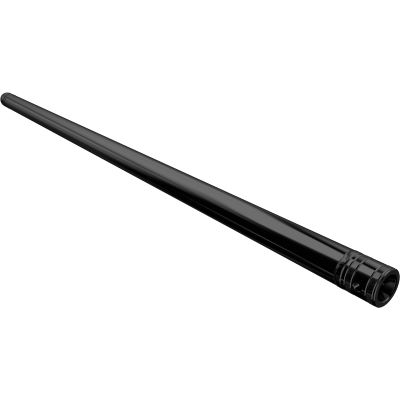
1-Point or Deco Truss
For suitable light decorative tasks, visual elements and applications where a conventional spatial lattice truss is not required.

2-point, 3-point or 4-point truss? Straight sections, corners, ground support or a stage lift? A truss system is a modular construction kit for lighting, event technology, exhibition stands and stages. The decisive factor is not only the cross-section of the truss, but the complete system of straight sections, connectors, supports, accessories and permitted loads.
First define what you actually want to build. A curtain support above a small stage has different requirements from a rectangular truss frame carrying moving heads or a complete ground-support system. Only afterwards should you compare individual series and their approved load data.
For suitable light decorative tasks, visual elements and applications where a conventional spatial lattice truss is not required.
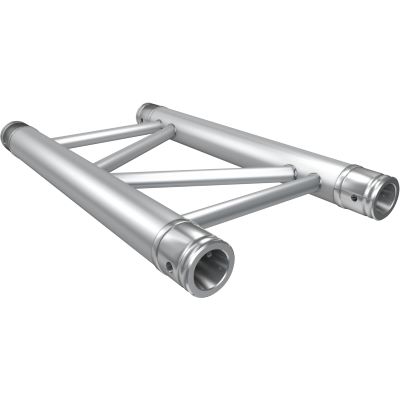
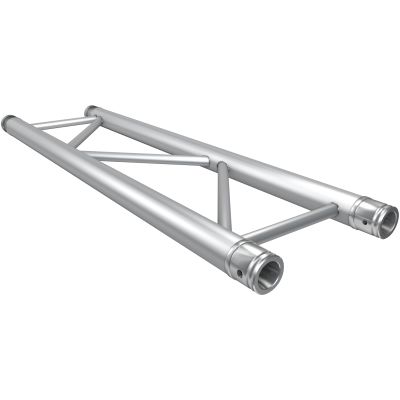
A slim system for curtains, molton and lighter lighting tasks. Its low structural height can also be useful where vertical space is limited.
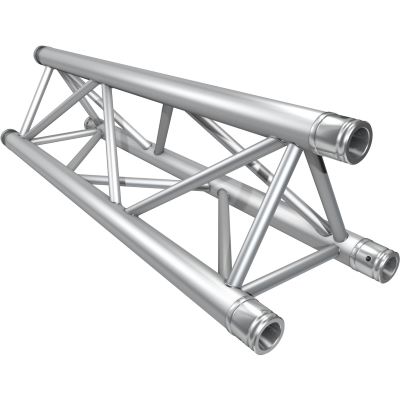
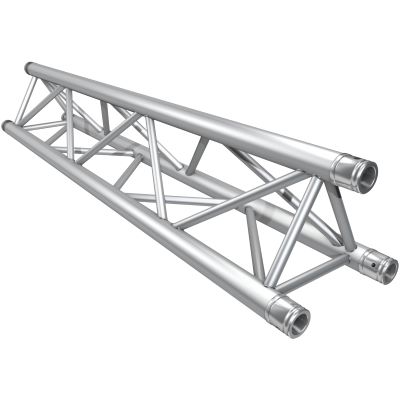
A triangular cross-section with spatial rigidity and a comparatively compact appearance. Frequently interesting for exhibition stands, circles and event constructions.
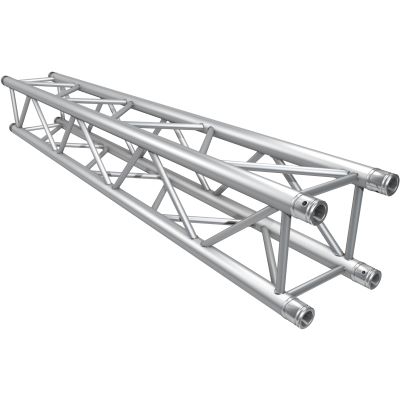
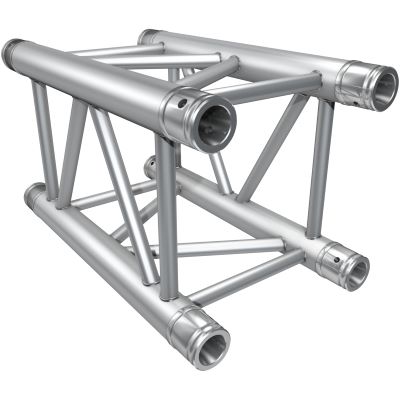
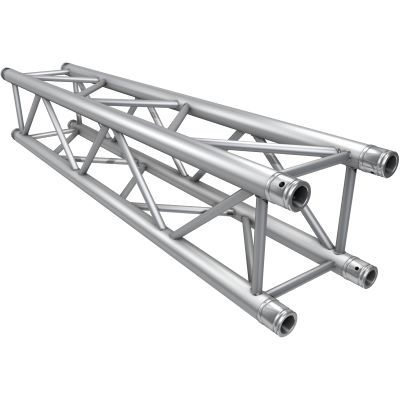
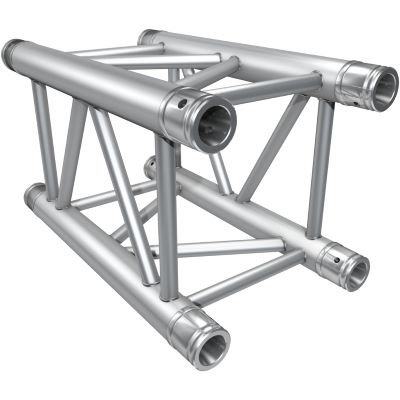
A square cross-section with high spatial rigidity and a very large variety of system components. It is frequently used for lighting supports, frames and ground-support structures.
Important: “4-point” does not mean that every construction can automatically carry any load or span any distance. The permitted values depend on the exact truss series, geometry, supports and load case.
Professional trusses usually use aluminium main tubes, known as chord tubes, connected by diagonal braces. This creates a lattice structure capable of achieving high bending and torsional rigidity while maintaining comparatively low self-weight.
The large longitudinal tubes form the main load-bearing structure. Many professional truss systems in the approximately 29 cm class use chord tubes around 50 mm in diameter.
Diagonal braces connect the chord tubes and create the lattice structure. They are not arbitrary suspension points for heavy equipment.
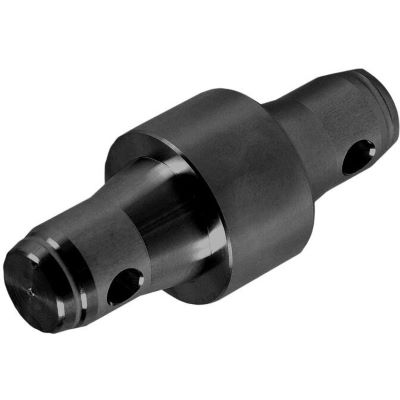
Many systems join straight sections and corners using conical connectors, bolts and retaining pins to form the intended mechanical connection.
Names such as F32, F33 and F34 identify defined system families. Accessories and geometry components must match the exact truss system being used.
| System | Construction | Typical Focus | Planning Consideration |
|---|---|---|---|
| 1-Point | Single tube | Decoration and light auxiliary applications | Highly application-specific |
| 2-Point | Flat lattice | Curtains, molton and lighter lighting tasks | Installation orientation matters |
| 3-Point | Triangle | Exhibition, design and special structures | Orientation must be considered |
| 4-Point | Square | Stage, lighting supports, frames and ground support | Very large variety of systems |
In simplified terms, the span is the distance between the load-bearing support points of a truss run. As this unsupported distance increases, bending moments and deflection become increasingly important. The same truss can therefore have very different permitted load values at different spans.
A shorter unsupported distance does not mean unlimited load capacity, but it creates different structural conditions from a long span.
As the span grows, the manufacturer's load table and permitted deflection become increasingly important.
Additional support points change the entire structural system. Such a construction must not simply be treated as several independent short truss spans.
Load type, span, orientation, number and position of supports and the truss's own weight all influence the construction. One kilogram figure without structural context is therefore insufficient.
A point load concentrates weight at a specific position, for example one heavy moving head. It affects the truss differently from several fixtures distributed evenly along the span.
Which table matters? Use the current technical documentation from the manufacturer for the exact truss series and construction. Load-bearing, flown and complex structures belong in qualified professional planning.
Straight sections, corners, box corners, connectors and other system components contribute their own weight.
Moving heads, PARs, loudspeakers, cables, curtains and other installed equipment contribute to the payload.
A heavy fixture in the centre of a span influences the system differently from a load close to a support point.
Outdoor constructions and temporary stage structures require their own qualified assessment of the complete system and environment.
Never calculate permitted load by eye: do not derive load capacity from chord-tube diameter, number of chord tubes or product weight. Use tested manufacturer data and qualified structural planning.
A common planning mistake is combining similar-looking truss series. F34 and F34P, for example, have different structural characteristics. Corners and conical connectors should only be combined where the manufacturer explicitly documents the intended compatibility.
Sections of 0.5, 1, 1.5 and 2 metres create a practical modular length grid. Very short pieces can solve precise dimensional adjustments.
Corners define the geometry of the frame. Not every corner orientation performs the same structural task.
Conical connections use the bolts and retaining elements specified for the system. Damaged connection components must be replaced or professionally assessed.
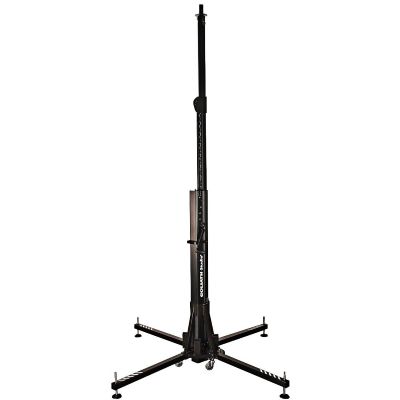
Suitable stage lifts or stands can be used for approved smaller mobile lighting constructions. Load capacity, truss adapter, footprint and manufacturer configuration must all match.
A flown system is suspended from structural rigging points designed for the purpose. Rigging hardware, suspension points and load distribution are planned by appropriately qualified professionals.
Ground support carries the upper truss structure using its own towers. Statics, assembly instructions and approved system components are integral parts of the complete construction.
Do not simply place a truss on two light stands: use only a system configuration explicitly designed for the truss, lifts, adapters and intended load.
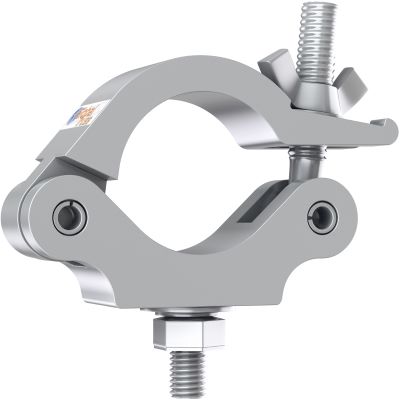
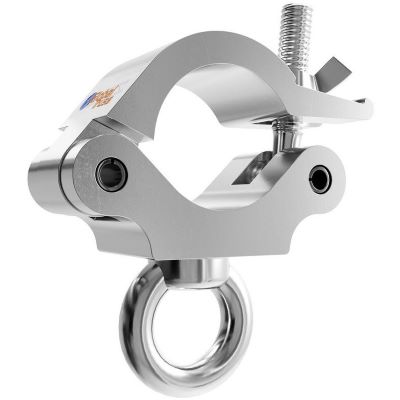
A half coupler wraps around a large part of the chord tube and can provide a defined attachment point for suitable equipment, depending on its approved configuration.
Two rotatable clamps allow particular tube-to-tube connections. The permitted load and intended use of the specific coupler must be observed.
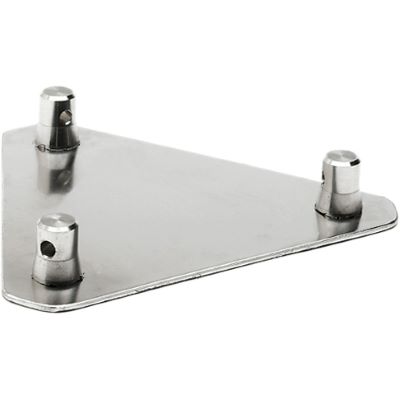
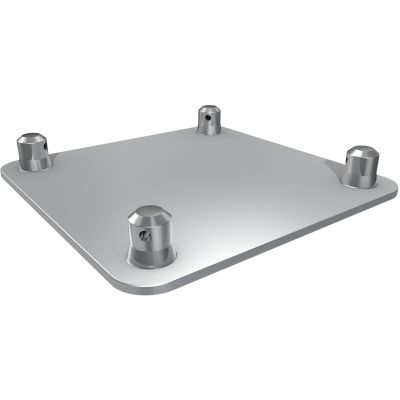
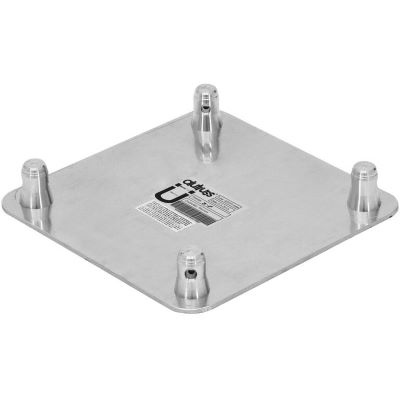
Matching system base plates are available for specific vertical or decorative applications. A base plate alone does not automatically make every freestanding truss construction safe.
Short spacing pieces, tower components and adapters solve specific geometry tasks within the system families for which they are designed.
The following selection shows several truss types and matching accessory components. Only combine parts from different series where the corresponding manufacturer documentation explicitly permits the combination.
Flat truss sections for suitable lighter event and exhibition applications.
View All 2-Point TrussTriangular truss and matching system plate for event and exhibition construction.
View All 3-Point TrussModular square truss sections and a system plate. F34P is a separate structural variant and its compatibility must be checked independently.
View All 4-Point Truss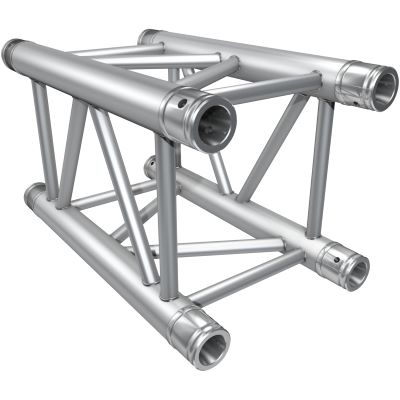

Select connection hardware according to system compatibility, tube dimensions, permitted load and intended use.
View Truss Accessories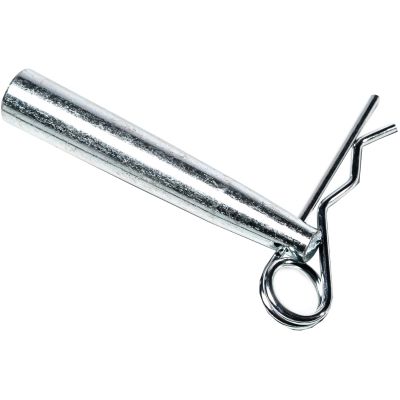

A professional lift is only one part of a complete approved truss-and-lift configuration.
View All Stage LiftsThe current Musikhaus Korn range includes Global Truss particularly in the F32, F33 and F34 families as well as clamps and connection technology. ALUTRUSS and Duratruss solutions cover additional truss, tower, connection and lifting applications.
Connect only components that the manufacturer explicitly identifies as compatible.
Span and load position influence the construction. Kilogram values cannot be added arbitrarily.
Attach equipment only at locations and chord tubes intended and approved for that purpose.
Tube diameter alone is not sufficient. Permitted load and intended application must also match.
Freestanding outdoor structures require their own qualified assessment of environmental and structural conditions.
Deformation, damaged welds or damaged connectors require competent professional assessment.
A truss is a lattice girder used in event technology, exhibition construction and installations. It consists of main chord tubes and connecting braces and can form part of a larger modular structure.
The number describes, in simplified terms, the number of longitudinal main chord tubes. This creates flat, triangular or square cross-sections with different structural characteristics.
A 2-point truss may be suitable for certain lighter applications. 3- and 4-point systems are frequently used for larger lighting structures. The decisive factor is always the load data for the exact truss series and construction.
No. The square construction offers high spatial rigidity, but an actual load capacity cannot be derived from that alone. Profile, material, span and overall construction determine the permitted values.
A conical connector joins two matching truss sections. Bolts and retaining pins secure the connection. Only components intended for the particular system should be used.
Only when compatibility is explicitly documented by the relevant manufacturer. Similar external dimensions or chord-tube diameters are not sufficient evidence of compatibility.
Ground support is a freestanding truss structure using its own towers to carry or raise an upper truss construction. Such systems require qualified overall planning.
Only with a system combination specifically intended for that purpose using suitable lifts or stands, truss adapters and truss. The load capacity and setup conditions of the complete system are decisive.
A point load concentrates weight at one specific position, for example a moving head. It affects the truss differently from a load distributed evenly along the span.
Use the current load tables and technical documentation from the manufacturer for that exact series, span, orientation and load type. Complex or flown structures should be planned by qualified professionals.
They are different system variants with different structural properties. Components should therefore not be combined solely because the names or dimensions appear similar. Check documented compatibility.
For infrequent larger events or complex ground-support constructions, a rental solution with suitable system components and technical personnel can be more practical than owning the complete system.
Plan modular stage surfaces, legs, stairs and platform connection technology together.
Suitable lifting solutions for approved mobile truss constructions.
Select PARs, moving heads and other fixtures to suit the stage and truss concept.
Select fastening equipment according to tube dimensions, load data and intended application.
2-point truss is slim and can be useful for lighter tasks. 3-point truss combines compact dimensions with spatial rigidity, while 4-point truss is a common basis for more extensive stage and event constructions. Afterwards, choose the exact series, straight lengths, corners, supports and accessories. Permitted loading always comes from the technical documentation for the specific construction – never from a generic kilogram figure for “a truss”.
Stage construction, lighting, PA systems, mixers, microphones, DJ technology, recording and musical instruments: the central Musikhaus Korn guide leads to further buying advice, comparisons and complete setup solutions.