Musikhaus Keks
Welcome!
Our cookies offer you a fast, relaxed and full-featured shopping experience. Some are necessary to operate the website and its functions. Others help us to improve our services. If you agree to this, simply consent to the use of cookies for preferences, statistics and marketing by clicking on "OK". Alternatively, you can deactivate individual cookies under "Customise cookies" or all cookies, except those required for the function of our website, under "Reject all".
Musikhaus Korn Buying Guide

Understanding Drum Sizes: Which Shell Sizes Suit You?

16, 18, 20 or 22-inch bass drum? A 10 or 12-inch tom? A 14" × 5.5" or 14" × 6.5" snare? Drum sizes influence much more than sound. They also affect playing feel, setup height, required floor space and transport. This guide explains how to read inch specifications correctly and how to choose a drum configuration that suits your body size, music style and intended use.

For Children & Adults Bass Drums, Toms & Snares Stage, Studio & Rehearsal Room
1" equals 2.54 cm
16–18" particularly compact bass drums
20" compact all-round size with lower setup height
22" widely used for rock and pop
Decoding Inch Specifications Correctly

What Does a Specification Such as 20" × 16" Mean?

In this guide, we use the common modern order diameter × depth. A 20" × 16" bass drum therefore has a 20-inch head diameter and a shell that is 16 inches deep.

Diameter

Diameter Influences Size and Tonal Range

Diameter affects the available tonal range and the amount of air that can be moved. With a bass drum, it also affects the overall setup height.

A smaller bass drum usually allows the rack toms mounted above it to be positioned lower.

Shell Depth

Depth Influences Response and Character

Two bass drums with the same diameter can behave differently if one has a 14-inch-deep shell and the other an 18-inch-deep shell.

Shallower shells are often chosen for their compact dimensions and direct response.

Complete Sound

Size Alone Does Not Determine the Final Sound

Drumhead type, tuning, damping, shell material, shell construction, hoops and the room all influence the result as well.

Inch sizes are therefore an important starting point, but not a complete description of a drum's sound.

Rule for comparing sizes: compare diameter and ergonomics first. Then consider shell depth, equipment and the desired sound character.
Example Configuration

20" / 10" / 12" / 14" / 14"

  • 20" × 16" bass drum
  • 10" × 7" rack tom
  • 12" × 8" rack tom
  • 14" × 13" floor tom
  • 14" × 6" or similarly sized snare

This type of progression provides clearly differentiated tonal ranges while keeping the overall setup comparatively compact.

This is one reason why 20-inch configurations are particularly interesting for many all-round and studio sets.

Important when buying drumheads: the head size must match the drum diameter exactly. A 20-inch bass drum requires a 20-inch bass drum head, regardless of the shell depth.
The Foundation of the Drum Set

16, 18, 20 or 22 Inches: Which Bass Drum Is Right for You?

The bass drum affects the tonal foundation, required floor space and the ergonomic height of the rack toms. Its size should therefore be considered early in the buying process.

Very Compact

16-Inch Bass Drum

Particularly small bass drums are common in junior and compact sets. They enable a low setup and require little space.

For children, this can be decisive because toms, pedals and cymbals remain easier to reach ergonomically.

Bop & Compact Stage

18-Inch Bass Drum

An 18-inch bass drum is a classic choice for compact jazz, acoustic and mobile setups.

It offers controlled response, is easy to transport and allows a low tom position.

Flexible All-Rounder

20-Inch Bass Drum

A 20-inch bass drum combines a compact setup with a full-size tonal foundation.

It works particularly well for pop, funk, studio work, lessons and versatile bands when a 22-inch drum feels too large spatially or ergonomically.

Rock & Pop Standard

22-Inch Bass Drum

The 22-inch bass drum is widely used in rock, pop and many all-round drum sets.

It provides a substantial tonal foundation and a large playing surface, but requires more room and raises rack toms mounted above it.

Direct Orientation

Compare Bass Drum Sizes by Space, Ergonomics and Application

Diameter Setup Typical Strength Particularly Interesting For
16" Very low and compact Space-saving, short reach Children, junior sets, small rooms
18" Low and easy to transport Fast, controllable response Jazz, acoustic music, small stages, mobile sets
20" Compact all-round setup Balance of foundation and ergonomics Pop, funk, studio, lessons, all-round use
22" Larger and higher Powerful foundation and projection Rock, pop, alternative, stage
24"+ Large; consider tom height Large acoustic volume and distinctive appearance Rock, vintage setups, specific sound goals
There is no rigid music-style rule: an 18-inch bass drum can work in rock and a 22-inch bass drum can work in jazz. Drumhead choice, tuning, damping, microphone technique and playing style can change the sound considerably.
From High Fills to a Low Final Note

How to Combine Tom Sizes Sensibly

Toms are generally combined so that the individual drums provide clearly distinguishable tonal ranges. Common modern combinations include 10"/12"/14" and 10"/12"/16".

Higher Range

8 and 10 Inches

Small rack toms cover the higher range of the drum set. A 10-inch tom is a common starting point in many current five-piece configurations.

An 8-inch tom can be added to larger tom setups or used in particularly compact configurations.

Middle Range

12 and 13 Inches

A 12-inch tom is particularly versatile. A 13-inch tom creates a larger interval from a 10-inch drum and is commonly found in more traditional combinations such as 12"/13"/16".

Floor Toms

14 and 16 Inches

A 14-inch floor tom keeps a set compact and combines particularly naturally with many 20-inch bass drum setups.

A 16-inch floor tom is a widely used lower voice in sets with a 22-inch bass drum.

Ergonomics before quantity: three toms provide little benefit if you can reach the highest rack tom only by lifting your shoulder. Position the snare and drum throne first, then the bass drum and pedals, and finally place the toms within a natural reach.
Consider Diameter and Depth Separately

Which Snare Size Fits Your Drum Kit?

A 14-inch diameter is particularly common for snare drums. Smaller 12- or 13-inch snares can be used as compact main snares or additional side snares.

Shell depth also influences playing feel and sound character. Very shallow snares around 3.5 to 5 inches are often selected for a fast, focused response.

Depths of approximately 5.5 to 6.5 inches cover a versatile range with more body, while even deeper snares can produce an especially full-bodied character.

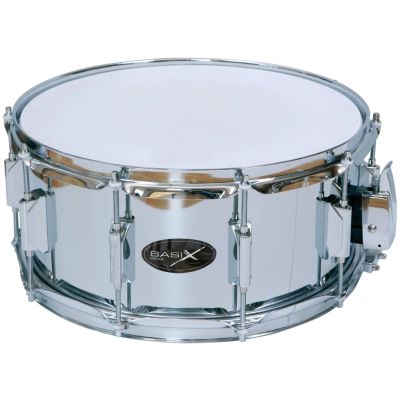
Gewa-Pure DC steel snare drum in 14 by 6.5-inch size
14" × 6.5" is a widely usable snare format with a 14-inch head diameter and 6.5-inch shell depth.
Ergonomics Instead of an Age Number

How Body Size and Bass Drum Diameter Are Connected

Particularly for children and smaller players, setup height determines whether the drum kit can be played in a relaxed position.

Junior Set

16-Inch Bass Drum

A 16-inch bass drum with small toms creates short reaching distances.

For children, this is often more useful than a full-size 22-inch set whose rack toms have to be positioned too high.

Compact Adult Solution

18- or 20-Inch Bass Drum

These sizes are particularly interesting when a low setup, compact footprint or easier transport is more important than maximum shell size.

Classic Band Setup

22-Inch Bass Drum

A 22-inch bass drum works very well for many adult players. The important point is that both rack toms remain easy to reach and do not have to be mounted unnecessarily steeply.

Practical test: sit on the correctly adjusted drum throne before judging a kit. You should be able to reach the snare, pedals, rack toms and cymbals without lifting your shoulders or stretching excessively.
Compare Real Configurations

Drum Sets Grouped by Bass Drum Size

The following products from the original guide illustrate how different shell dimensions are combined in actual junior, compact, all-round and rock/pop drum sets.

All Drum Sets
Junior, 16 & 18 Inches

Compact Drum Sets for Children, Small Rooms and Mobile Use

Small shells are useful for children, restricted spaces and mobile applications. The complete size progression matters, not only the bass drum diameter.

16-Inch Bass Drum

STAGG TIM JR 5/16B RD

16" bass drum with 8"/10" rack toms and a compact 12" floor tom.

Junior

PURE GEWA Basix Junior

Compact 16-inch configuration designed around shorter reaching distances for smaller players.

18-Inch Bass Drum

TAMA Club Jam LJK48S-AQB Demo

Shallow shells and an 18-inch bass drum create a particularly compact setup for small stages and mobile use.

20-Inch All-Round Sets

Compact Foundation with Full-Size Tom Dimensions

A 20-inch bass drum can create a lower, more compact setup without reducing the drum kit to a junior configuration.

Sonor

Sonor AQ1 Studio Piano Black

20-inch bass drum with 10", 12" and 14" toms.

TAMA

TAMA Stagestar 20" Black Night Sparkle

Compact Stagestar configuration for versatile applications.

Mapex

Mapex Comet Fusion Indigo Blue

20" bass drum with compact 10"/12"/14" tom progression.

STAGG

STAGG TIM120B WR

20-inch configuration with 10"/12"/14" tom sizes for a straightforward all-round setup.

22-Inch Drum Sets

Large Foundation for Rock, Pop and Band Rehearsals

The 22-inch category includes both modern 10/12-inch rack-tom setups and more traditional 12/13-inch combinations.

TAMA

TAMA Imperialstar 6-Piece Hairline Black

22-inch bass drum plus two rack toms and two floor toms.

Gretsch Drums

Gretsch Energy Black

Classic 22"/10"/12"/16" drum-size progression.

Yamaha

Yamaha Rydeen JRDP2F5BLGCP

22-inch bass drum with a typical versatile rock and pop configuration.

TAMA

TAMA Stagestar 22" Black Night Sparkle

Five-piece drum set with a large 16-inch floor tom.

Gretsch Drums

Gretsch Renegade Grey Sparkle

22-inch set with 10", 12" and 16" toms.

STAGG

STAGG TIM122B BL

22-inch bass drum with the more traditional 12"/13"/16" tom progression.

Build the Configuration Individually

Shell Sets and Individual Snares for Targeted Size Selection

If you already own hardware and cymbals, a shell set allows you to choose bass drum and tom sizes more deliberately. A separate snare can then be selected independently from the rest of the configuration.

Shell Set

Gretsch Catalina Maple CM1-E825-WG

A shell set for building an individually completed acoustic drum configuration around the desired shell sizes.

Snare · 14" × 6.5"

Gewa-Pure DC Steel Snare

Classic 14-inch diameter combined with a 6.5-inch shell depth for a versatile main-snare format.

Do Not Forget Diameter When Buying Accessories

Choose Drumheads, Hardware and Cymbals to Match the Set

Bass Drum Heads

Head Diameter Must Match Exactly

Batter and resonant heads must have exactly the same diameter as the bass drum.

Snare Heads

Diameter Also Determines Snare Head Size

With a snare drum, the diameter determines the required head size as well. Shell depth does not change the diameter of the drumhead.

Drum Hardware

Hardware Must Allow the Desired Setup

Stands and tom holders must provide enough adjustment range. With large bass drums, flexible tom positioning is particularly useful.

Cymbal Sets

Cymbal Sizes Are Independent of Shell Diameter

Cymbals do not have to match the drum-shell dimensions. They should, however, fit the available space and remain within the player's comfortable reach.

Manufacturer Size Worlds

Discover Drum Brands and Different Set Configurations

Manufacturers combine bass drum, tom and snare dimensions differently across their series. Comparing complete ranges is therefore worthwhile even after you have decided on a preferred bass drum diameter.

Frequently Asked Questions About Shell Sizes

Answers About Bass Drums, Toms and Snares

What Does 22" × 16" Mean on a Bass Drum?
In this guide, 22" × 16" means a 22-inch diameter and a 16-inch shell depth. For a replacement drumhead, the 22-inch diameter is the relevant measurement.
Is a 20- or 22-Inch Bass Drum Better for Beginners?
Both can work very well. A 20-inch bass drum allows a slightly more compact and lower setup. A 22-inch bass drum is the classic size in many rock and pop configurations. Body size and the desired tom position are often more important than experience level.
Which Drum Size Is Suitable for Children?
For younger or smaller children, junior sets with approximately a 16-inch bass drum and reduced tom sizes are often more ergonomic. The important point is that the pedals, snare, toms and cymbals can all be reached comfortably.
Can I Play Rock with an 18-Inch Bass Drum?
Yes. Drum size does not prescribe a musical style. Tuning, heads, damping, playing technique and microphones can make a compact bass drum sound very different.
Does a Larger Drum Automatically Sound Lower?
A larger diameter generally extends the available lower tonal range, but the final sound also depends on the drumhead, tuning, shell depth, material and damping.
Why Does the Bass Drum Affect the Height of the Toms?
Rack toms are often mounted above or partly over the bass drum. The larger the bass drum diameter, the higher its upper edge. Smaller players can therefore often achieve a flatter tom position with an 18- or 20-inch bass drum.
Is 10, 12 and 14 Inches a Good Tom Combination?
Yes. The 10"/12"/14" combination is compact and versatile. A 10"/12"/16" setup creates a larger interval to the floor tom, while 12"/13"/16" is closer to a more traditional configuration.
Which Snare Size Is the Most Versatile?
A 14-inch diameter is a very common starting point. Depths of approximately 5.5 to 6.5 inches cover many applications. Material, heads and tuning remain equally important.
Can I Add Different Tom Sizes Later?
In principle, yes. Check whether matching individual shells are available for the series and finish and whether your tom holders, stands and available floor space can accommodate the additional drum.
Does a New Drumhead Have to Match the Shell Depth?
No. The drumhead size is determined by the drum diameter. A 20" × 14" bass drum and a 20" × 18" bass drum both use a 20-inch drumhead.
Do Not Buy by Inches Alone

The Best Drum Size Must Suit Your Body and Your Application

Compare bass drum diameter, tom position, floor space and equipment as one complete system.

A smaller bass drum can make the complete setup significantly easier to play without automatically limiting the musical possibilities. The Musikhaus Korn team can help you find an ergonomic configuration and the appropriate accessories.

Final Size Checklist
  • Can you operate both pedals comfortably?
  • Can you reach both rack toms without lifting your shoulders?
  • Does the bass drum fit the available floor space?
  • Are the tom sizes clearly differentiated?
  • Does the snare height work with your seating position?
  • Are matching drumheads available in the required diameters?
  • Can the kit be transported and expanded as required?
Understanding Drum Sizes Makes Choosing a Set Easier

Understanding Drum Sizes: 16–22 Inches

The bass drum determines an important part of the tonal foundation of a drum set, but it also influences floor space and setup height. Small 16- and 18-inch bass drums are particularly useful for compact configurations, while 20 inches provides a versatile middle ground. A 22-inch bass drum is widely used for rock, pop and many traditional band setups.

With toms, graduated diameters such as 10", 12" and 14" or 10", 12" and 16" create different tonal ranges. A 14-inch diameter is particularly common for snare drums, while shell depth adds another important influence on character.

The final sound always results from the interaction between size, drumhead, tuning, shell construction and playing technique. Before buying, the complete set should also suit the player's body size. A lower bass drum can allow a more ergonomic tom position, while larger drums require more space.

More Guidance

Choose More Instruments and Setups with Confidence

Discover further buying guides covering instruments, drums, studio equipment, DJ gear and event technology and build your equipment step by step around your actual application.