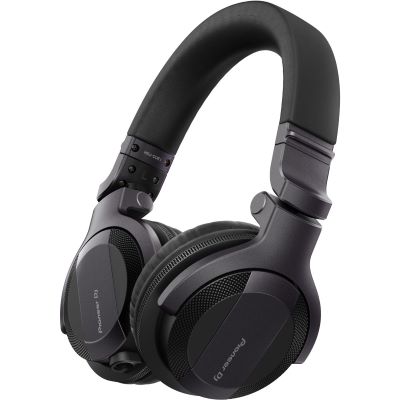
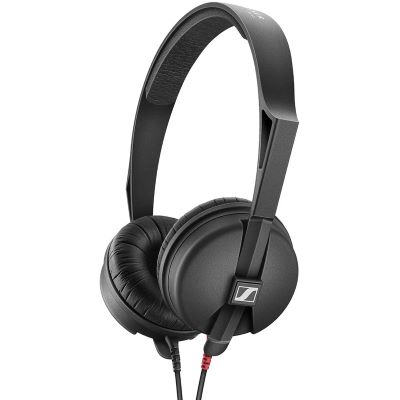
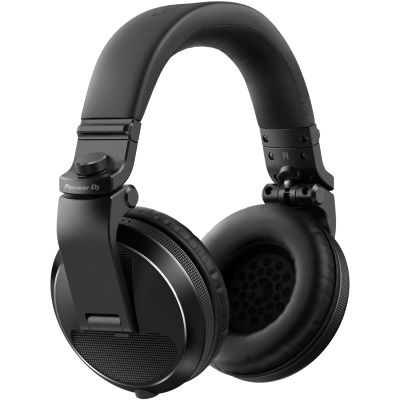
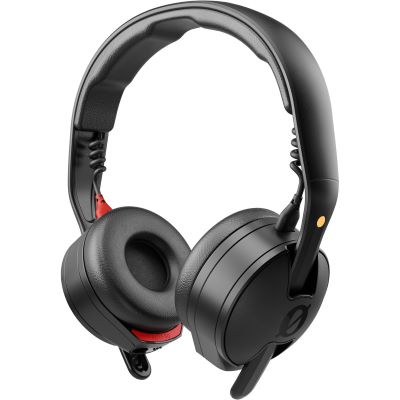
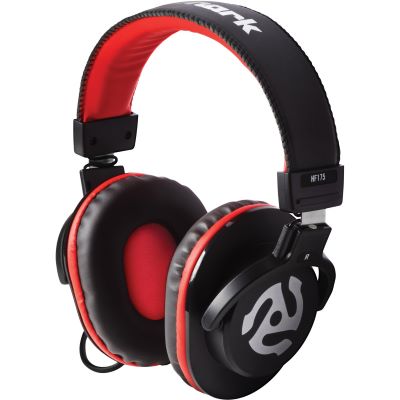
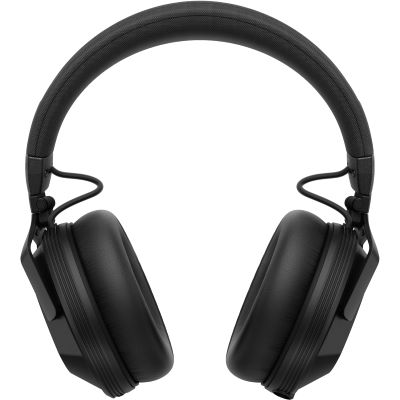
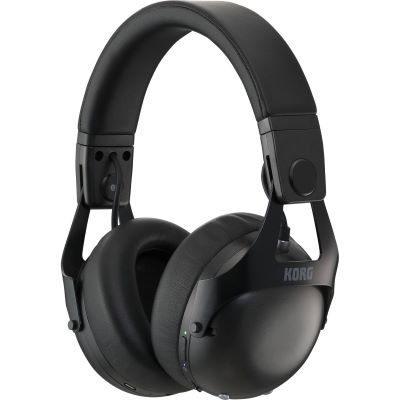
Closed-Back Construction
A closed design reduces the influence of club or PA volume and makes it easier to identify kicks, snares, cue points and transitions in the headphone signal.

DJ headphones have to work in loud environments, move quickly between both ears, one ear and your neck, and reproduce the next track clearly enough to prepare beats, cue points and transitions reliably. Sound and frequency response are therefore only part of the decision. Construction, isolation, weight, rotating ear cups, cables, spare parts and one-ear monitoring determine how well a pair of headphones really works in everyday DJ use.
Good passive isolation is often more useful than simply increasing headphone volume. The less club sound enters the ear cup, the easier it is to hear the Cue signal at a sensible monitoring level.
For DJ use, headphones should isolate reliably, provide sufficient level reserve and move quickly between both ears, one ear and your neck. Comfort and durability are just as important during long sets as the sound itself.
A closed design reduces the influence of club or PA volume and makes it easier to identify kicks, snares, cue points and transitions in the headphone signal.
Headphones should not slip while you move, but they should also avoid unnecessary pressure on your head and ears after several hours of use.
Swivelling or rotating ear cups make quick one-ear monitoring and switching between the Cue signal and Booth loudspeaker considerably easier.
Replaceable cables and ear pads can significantly extend service life, especially when headphones are transported regularly between clubs, events and rehearsal rooms.
Practical rule: good passive isolation is often more valuable than simply increasing headphone volume. The less club sound enters the ear cup, the easier the Cue signal is to identify at a reasonable monitoring level.
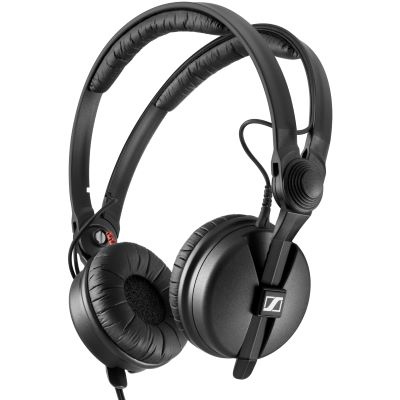
On-ear models such as the Sennheiser HD 25, AIAIAI TMA-2 DJ XE or Pioneer DJ HDJ-CX sit directly on the ear and are often particularly light.
Many DJs prefer this construction because one ear cup can be removed and repositioned very quickly.
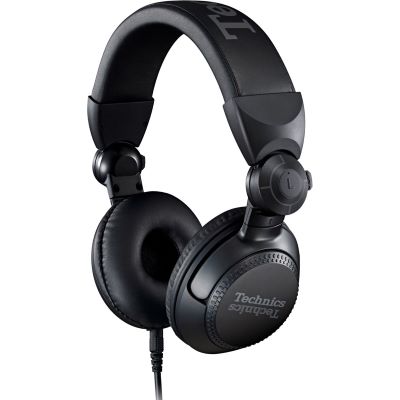
Circumaural headphones can provide stronger passive isolation and spread contact pressure over a larger area around the ear. This is useful in loud booths, although the fit may feel warmer depending on the pads and clamping force.
Open headphones deliberately allow external sound to pass through and are useful for certain studio and HiFi tasks. In the DJ booth, however, you normally want a clearer distinction between Cue signal and room volume.
Which construction is best? The one that sits securely on your head and remains easy to operate during real DJ movements. Put the headphones on, free one ear, move your head and fold or rotate the cups. This often tells you more than a specification list.
During beatmatching, rhythmic transients need to remain clear enough to compare two tracks against one another. Good isolation prevents room sound from masking the Cue signal unnecessarily.
Leather-like pads often seal more tightly than very airy materials. Worn pads may therefore not only become less comfortable, but can also change the acoustic isolation.
DJ headphones should provide enough useful level from the mixer or controller. Start at a low level and increase it only as far as necessary for reliable monitoring.
Many DJs wear only one ear cup. One ear hears the Cue signal, while the other hears the Booth monitor or PA. For this to remain comfortable, the ear cup needs to move away from the ear without awkward head or hand positions.
Low weight can reduce strain on your head and neck during long sets. This is one reason compact on-ear headphones remain popular with many DJs.
Higher pressure can improve isolation, but it has to suit your head. DJs who wear glasses should pay particular attention to pressure points.
Dense materials often isolate well, while softer materials can change long-session comfort. Replaceable pads are a major advantage for heavily used headphones.
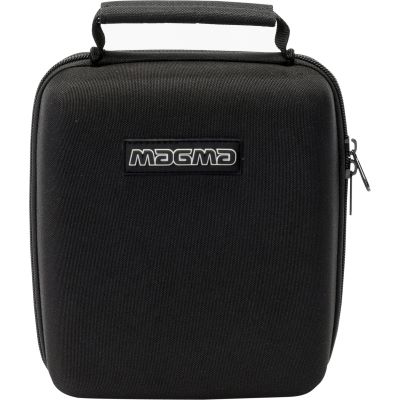
Foldable headphones require less room in a DJ bag. If the design does not fold, a suitable protective case helps protect hinges and ear cups in transit.
DJ headphones commonly use impedances that work well with mixers, controllers and mobile equipment. Impedance alone does not tell you how loud the headphones will actually play.
Sensitivity, driver design and the headphone amplifier also need to be considered.
Both 40 mm and 50 mm drivers are common in professional DJ headphones. A larger driver is not automatically better: tuning, housing design and efficiency are at least as important.
DJs mainly need bass impulses, mids and transients to remain recognisable under real monitoring conditions. Practical clarity matters more than spectacular numbers at the edge of a specification sheet.
Practice beats specifications: headphones with a comfortable fit, useful isolation and a clearly recognisable kick can be better for DJing than a model with more impressive numbers that does not sit properly.
Models such as the HDJ-CUE1BT combine DJ-oriented construction with wireless music listening. For precise Cueing and beatmatching, the wired connection remains the safest reference.
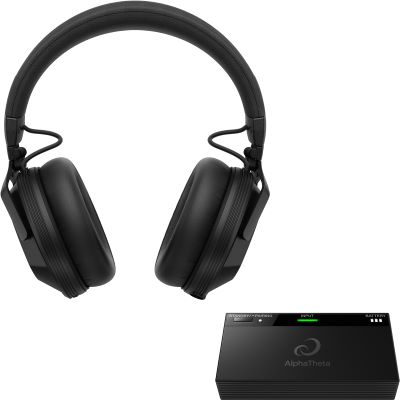
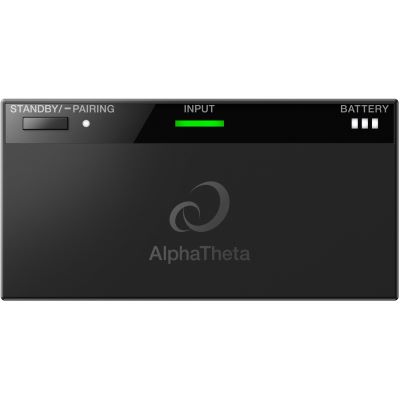
AlphaTheta HDJ-F10 can operate with the HP-TX01 transmitter through SonicLink. Compatible AIAIAI systems use their own low-latency wireless performance connection.
Battery, transmitter and radio connection are additional components. For important gigs, a functioning wired backup remains a very sensible safeguard.
| Design | Strength | Handling | Typical Application |
|---|---|---|---|
| Closed On-Ear | Light and compact | Very fast | Club, mobile, one-ear monitoring |
| Closed Over-Ear | Strong enclosure | Larger | Loud booth, long sessions |
| Bluetooth DJ Model | Everyday use + wired operation | Flexible | Preparation, travel, home |
| Low-Latency Wireless | Wireless DJ monitoring | Consider transmitter and battery | Performance, professional booth |
Closed models for cueing, live mixing and club monitoring.
Wireless transmitters, cases, holders and headphone amplifiers.
Ear pads, cables and replacement components for compatible models.
Cue/Master, Split Cue and dedicated headphone outputs.
Controllers with independent Cue outputs and headphone control.
Independent players used with separate mixers and headphones.
Bedroom and monitoring loudspeakers to complement headphones.
Controllers and suitable DJ headphones combined as a package.
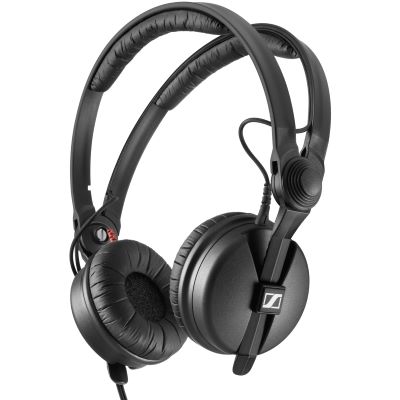
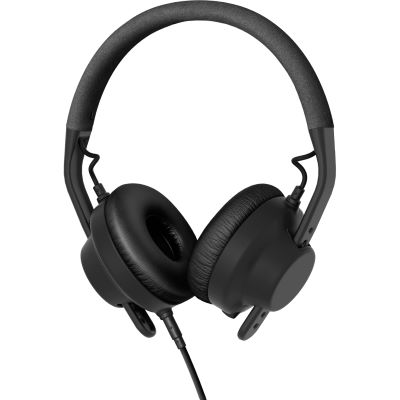

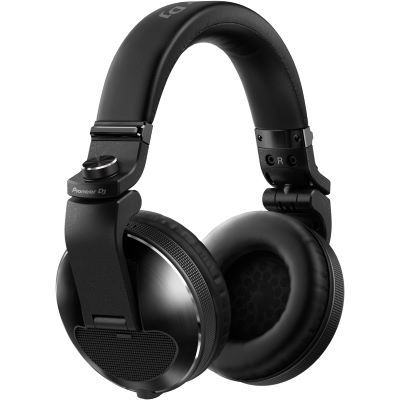
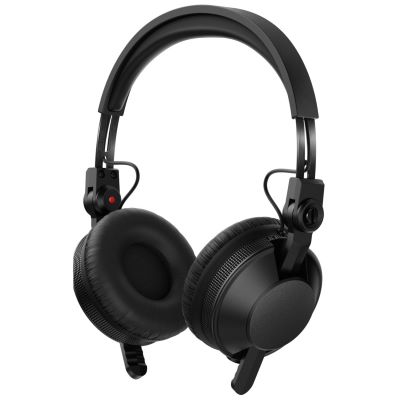








Isolation and fit strongly influence how clearly the Cue signal can be heard inside a loud booth.
A normal consumer Bluetooth connection is not automatically suitable for precise, time-critical Cueing.
Pressure points and heat often appear later. Weight and clamping force therefore belong in the buying decision.
Frequent packing and unpacking stresses connectors. Replaceable cables make repair and replacement much easier.
Many professional mixers use the large headphone jack. A suitable adapter therefore belongs in the DJ bag.
Hinges and ear cups are unnecessarily stressed when headphones move freely between power supplies, cables and other equipment.
A closed construction reduces outside noise and makes it easier to hear the Cue signal and beats clearly next to a loud PA.
On-ear headphones are often lighter and especially quick for one-ear monitoring. Over-ear headphones can surround the ear more completely and may therefore provide stronger passive isolation in loud environments.
The HD 25 is designed for high sound levels and monitoring in loud environments, has a rotating ear cup and uses a modular construction. This makes it suitable for many classic DJ workflows.
There is no single ideal value. What matters is how efficiently the headphones work with your mixer or controller. Impedance and sensitivity should be considered together.
Not necessarily. For DJs who frequently Cue with only one ear, a movable ear cup makes switching between the Cue signal and Booth monitor considerably easier.
For normal music listening, yes. For precise beatmatching, ordinary Bluetooth latency can be problematic. A cable or dedicated low-latency DJ wireless system is better suited to time-critical Cueing.
It remains compact during normal operation and can extend when you move farther away. A straight cable is lighter and can create less pulling force in some mobile applications.
Yes, especially with regular use. Ear pads are wear parts and influence both comfort and acoustic sealing. Replaceability can significantly extend the service life of the complete headphones.
Good isolation, secure fit, sufficient level reserve, fast one-ear handling and robust construction are generally more important than unusual additional features.
Pay particular attention to weight, clamping force, ear pads and your own head shape. Lightweight on-ear and well-padded over-ear models use different comfort concepts.
For important events, a reliable backup path is useful. This can be a second simple pair of headphones or, with modular models, a replacement cable plus the correct adapter.
For bedroom DJs, a well-isolating and comfortable pair of headphones with a reliable cable and clearly recognisable rhythm is already enough. DJs who regularly work at events or in clubs should additionally consider strong hinges, replaceable parts, interchangeable cables and fast one-ear monitoring.
Whether on-ear or over-ear is mainly a question of head shape, isolation and personal workflow. A lightweight HD 25- or TMA-2-style design feels very different from a large closed HDJ-X model, but both concepts can work extremely well in a club.
With wireless systems, transmission technology is crucial. Normal Bluetooth is convenient for listening and preparation, while time-critical DJ monitoring requires a wired connection or technology specifically designed for low latency. Do not test sound alone: test putting the headphones on, rotating them, Cueing and wearing them for longer periods. That is where the right DJ headphone reveals itself.
From DJ headphones, controllers and mixers to media players, vinyl and DVS as well as studio equipment, musical instruments and event technology, the central Musikhaus Korn guide contains further comparisons, buying advice and practical knowledge.