
Buying a Synthesizer – Soundscapes for the Studio, Stage, and Sound Design
What Is a Synthesizer?
A synthesizer is an electronic musical instrument that doesn’t simply play back sounds, but rather generates, shapes, and modifies them. While a traditional keyboard often provides many pre-programmed instrument sounds, the synthesizer focuses on sound design. Simple fundamental waves are transformed into basses, leads, pads, effects, drum sounds, and experimental textures. That’s exactly why synthesizers have become an indispensable part of electronic music, pop, rock, film scoring, ambient, techno, hip-hop, and modern live performance.
In Musikhaus Korn’s synthesizer selection, you’ll find compact entry-level models, classic analog synthesizers, modern digital synthesizers, workstations, desktop units, and modular systems. The great appeal lies in the fact that a synthesizer is never just a single sound. Rather, it’s a tool you use to create sounds yourself. Depending on the model, you can control oscillators, filters, envelopes, LFOs, effects, sequencers, and modulation paths directly via knobs, faders, keys, or displays.
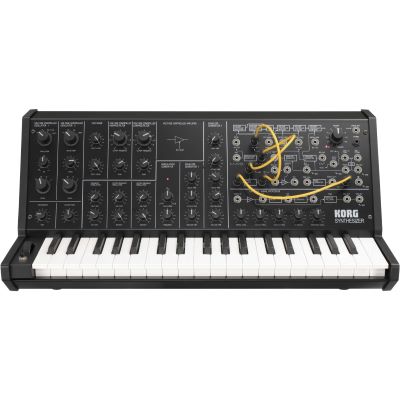
The Synthesizer as a Creative Instrument
A synthesizer responds very directly to musical ideas. Even small changes to the filter, envelope, or modulation can completely transform a sound. This creates a playful approach to music production: you turn a knob, hear the result immediately, and develop new ideas from there. For many musicians, it is precisely this direct connection to the sound that is the most important difference from purely software-based workflows.
How does a synthesizer work?
Most synthesizers consist of several components that work together to produce the sound. It all starts with the oscillator. It provides the fundamental waveform—for example, a sawtooth, square, triangle, or sine wave. This waveform is then shaped by filters, amplifiers, envelopes, and modulators. This transforms a simple signal into a vibrant sound with attack, movement, impact, and character.
The Key Components of Sound Generation
Oscillators
Oscillators are the sound source of a synthesizer. Analog models generate their waveforms using electronic circuits, while digital models calculate them internally. Many modern instruments offer multiple oscillators that can be detuned, synchronized, or modulated with one another. This creates fat basses, wide leads, or floating pads.
Filter
The filter determines which frequency ranges remain audible in the sound. A low-pass filter lets low frequencies through and cuts off the highs. A high-pass filter does the opposite. Bandpass and notch filters enable additional timbres. Things get particularly interesting with resonance: it emphasizes the range around the filter frequency and can give a sound sharpness, a whistling quality, a sharp edge, or a singing character.
Envelopes and LFOs
Envelopes control the temporal progression of a sound. They determine whether a sound starts immediately, swells slowly, decays briefly, or is sustained for a long time. LFOs work similarly but repeat their movement continuously. This allows you to create vibrato, tremolo, filter modulations, rhythmic pulsations, and many other effects.
Typical parameters of an ADSR envelope
- Attack: How quickly a note starts after being played.
- Decay: How quickly the sound drops to a sustain level after it starts.
- Sustain: How loud the note is sustained as long as the key remains pressed.
- Release: How long the sound fades out after the key is released.
What types of synthesizers are there?
Synthesizers differ not only in sound but also in operation, design, and intended use. If you’re thinking about buying a synthesizer, you should first consider how you plan to use the instrument: for learning, for basslines, for pads, for live sets, for studio work, for modular experiments, or as a central production hub.
Analog Synthesizers
Analog synthesizers use electronic circuits and are often prized for their warm, direct, and organic sound. They’re particularly well-suited for punchy basslines, distinctive leads, soft pads, and classic electronic sounds. Many analog units feature a straightforward interface with direct controls. This makes them attractive to beginners because it’s easy to understand how the sound is built up.
Digital Synthesizers
Digital synthesizers offer tremendous flexibility. They can combine virtual-analog sounds, wavetables, FM sounds, granular textures, samples, or complex modulation systems. This makes them ideal for modern productions, sound design, film scores, and detailed soundscapes. Instruments like the Roland Jupiter XM synthesizer demonstrate just how compact and versatile digital sound generation can be today.
Hybrid Synthesizers
Hybrid models combine digital oscillators with analog filters or analog sound generation with digital control. This design is popular because it combines the sonic diversity of digital technology with the character of analog signal processing. The Arturia MicroFreak synthesizer is a good example of a compact instrument with experimental digital sound generation and a unique control concept.
Modular and Semi-Modular Synthesizers
In modular synthesizers, the signal path is built using patch cables. You decide which modules to connect to each other. Semi-modular synthesizers come with internal wiring but can also be patched further. If you want to delve deeper into sound design, you’ll find plenty of options for custom setups in the Modular Systems and Synthesizer Modules category.
Synthesizer, Keyboard, Sampler, or Workstation?
These terms are often used interchangeably, but they refer to different types of instruments. A synthesizer generates sounds through synthesis. A sampler plays back recorded sounds and processes them. A keyboard usually offers many preset sounds, auto-accompaniment, and learning functions. A workstation combines a synthesizer, sequencer, effects, sampler, and performance functions in a single device.
If you’re primarily interested in playing, practicing, or using accompaniment features, it’s worth checking out the “Buy Keyboards” page at Musikhaus Korn. If you want to create complete songs on a single instrument, workstation synthesizers are a great option. For beat production, sample performance, and rhythmic ideas, hardware samplers, grooveboxes, sequencers, and drum machines are also great options.
Rack and Desktop Synthesizers
Not every synthesizer has a keyboard. Rack and desktop synthesizers are ideal if you already use a MIDI keyboard, a DAW, or a hardware sequencer. They save space but often deliver the same sonic power as larger keyboard models.
When is a desktop synthesizer a good choice?
A desktop unit is a good fit if you work with external controllers, are planning a compact live setup, or want to combine multiple sound generators in the studio. Many producers use desktop synthesizers as dedicated sound sources alongside an audio interface, mixing console, and computer.
Advantages of compact units
- Space-saving in the studio and on your desk
- Flexible control via MIDI, USB, or sequencer
- Easily combinable with existing keyboards
- Ideal for live sets with multiple sound sources
Popular Synthesizer Manufacturers
At Musikhaus Korn, you’ll find many well-known brands, each with its own sound aesthetic and user interface. Korg is known for versatile synthesizers, workstations, and creative sound machines. Arturia combines classic synthesizer concepts with modern user interfaces. Novation excels in synthesizers, controllers, and performance-oriented devices. Moog is closely associated with analog sound, filter character, and the modular tradition. Roland offers synthesizers, drum machines, stage instruments, and modern performance tools.
Which brand suits which sound goal?
For classic analog sounds, basslines, and leads, Korg, Moog, Novation, and Sequential are often exciting options. For versatile digital soundscapes, layering, performance, and modern sounds, Roland, Yamaha, Waldorf, or Korg workstations are worth considering. Arturia appeals to many musicians with its compact instruments, intuitive controls, and experimental sound concepts.
Product Examples at Musikhaus Korn
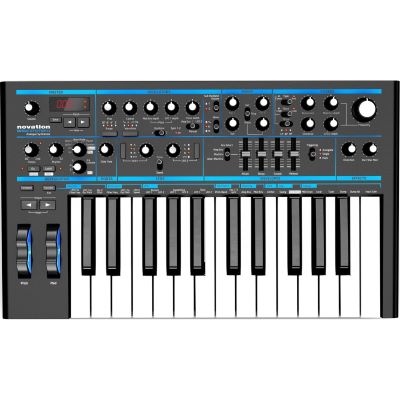
The following examples showcase different approaches: classic analog, experimental hybrid, bass-oriented, and performance-focused. This selection is intended as a guide and can be expanded depending on your desired sound, budget, keyboard range, and setup.


What should you look for when buying a synthesizer?
Sound Character and Musical Style
The most important factor is your musical goal. For techno, house, and electronic basslines, a monophonic analog synthesizer may be all you need. For ambient, soundtracks, and wide pads, a polyphonic synthesizer with effects is worth considering. For modern pop production, live keyboarding, and songwriting, a workstation or a digital performance synthesizer may be the better choice.
Keyboard, Controls, and Connections
The number of keys determines how you play. Compact models with 25 or 37 keys are easy to transport and ideal for sequences or basslines. 49 or 61 keys provide more room for chords and two-handed playing. If you don’t have your own keyboard, an external MIDI keyboard or master keyboard becomes essential.
Important Connections
- Audio outputs for a mixing console, audio interface, or amplifier
- Headphone output for practicing and producing
- USB for computers, DAWs, and editor software
- MIDI In/Out for hardware setups
- CV/Gate for modular or semi-modular systems
Memory slots and presets
Some synthesizers are deliberately minimalist and don’t store any sounds. Others offer hundreds of presets and memory slots for your own patches. For live musicians, the ability to save sounds is very practical because it allows them to be recalled quickly. For sound designers, a minimalist device can be appealing because each sound is created anew, and the focus is more on the moment.
Effects, sequencers, and arpeggiators
Built-in effects such as reverb, delay, chorus, distortion, or phaser enhance the sound directly within the unit. A sequencer stores sequences of notes, while an arpeggiator rhythmically breaks down chords into individual notes. These features make a synthesizer particularly inspiring, as ideas can quickly turn into grooves, patterns, and complete song sections.
Frequently Asked Questions About Synthesizers
What is the difference between a synthesizer and a keyboard?
A keyboard is usually designed for versatile playing with preset sounds, auto-accompaniment, and learning features. A synthesizer focuses more on sound generation and sound shaping. While many synthesizers also have keys, they offer significantly greater control over the sound.
Which synthesizer is best for beginners?
For beginners, intuitive instruments with straightforward controls are ideal. A compact analog synthesizer, an easy-to-use digital model, or a hybrid instrument with presets and a clear interface often make for a good starting point. It’s important that you can easily understand the oscillator, filter, envelope, and modulation.
Is analog better than digital?
Analog and digital aren’t tiers of quality, but rather different approaches to sound. Analog synthesizers often sound direct, warm, and full of character. Digital synthesizers are frequently more flexible, offer more storage options, and are more versatile. Many musicians use both because they complement each other perfectly.
Can I produce entire songs with a single synthesizer?
With a single synthesizer, you can create many key elements of a song, such as bass, melody, pads, or effects. For complete productions, depending on your workflow, you’ll also need a drum machine, sampler, sequencer, DAW, or a workstation. Synthesizers and samplers, in particular, complement each other very well.
Do I need a computer?
Not necessarily. Many synthesizers work entirely without a computer. You can play them directly, connect them to a mixing console, or link them to other hardware devices. A computer becomes particularly useful if you want to record, arrange, edit, or integrate software instruments.
What does polyphony mean?
Polyphony describes how many notes a synthesizer can play at the same time. A monophonic synthesizer plays one note at a time and is particularly well-suited for bass and leads. A polyphonic synthesizer can produce chords, pads, and complex harmonies.
Discover synthesizers at Musikhaus Korn
A synthesizer is an instrument for anyone who wants to do more than just select sounds—they want to truly shape them. Whether you’re looking to buy your first synthesizer, expand an existing studio, or plan a flexible live setup, at Musikhaus Korn you’ll find the right categories, manufacturers, and product options to meet your specific needs. Start by browsing the Synthesizers category or get an overview of synthesizers and samplers.
If you already know what kind of sound you’re looking for, you can filter specifically for analog, digital, hybrid, or modular models. If you’re still undecided, it’s worth comparing different designs. After all, the best synthesizer isn’t automatically the biggest or most expensive one, but the instrument that fits your sound, your workflow, and your musical vision.