Musikhaus Keks
Welcome!
Our cookies offer you a fast, relaxed and full-featured shopping experience. Some are necessary to operate the website and its functions. Others help us to improve our services. If you agree to this, simply consent to the use of cookies for preferences, statistics and marketing by clicking on "OK". Alternatively, you can deactivate individual cookies under "Customise cookies" or all cookies, except those required for the function of our website, under "Reject all".
Musikhaus Korn Buying Guide

Microphones for Wind Instruments: Choosing Clip, Stand or Wireless Correctly

Saxophone, trumpet, trombone, clarinet and concert flute radiate their sound in different ways. The result therefore depends not only on the microphone, but also on its position. Clip microphones provide consistent pickup and plenty of freedom of movement on stage. A microphone on a stand allows greater distance and a more natural overall sound. Dedicated wireless systems are another option for mobile soloists.

Saxophone to Trumpet Live & Studio Explained Compare Cable & Wireless
Choose by Application Rather than Data Sheet

Which Microphone Suits Your Wind Instrument?

Stage, studio and rehearsal room place different demands on a microphone. Start by deciding how freely you want to move and how much of the surrounding room should become part of the signal.

Live

Clip Microphone

Mounted directly on the instrument. The distance to the sound source remains constant while you move – particularly practical for saxophone, trumpet and trombone.

Studio

Microphone on a Stand

More distance allows the microphone to capture more than a single sound outlet. This can create a more balanced overall image, particularly with woodwind instruments.

Freedom of Movement

Wireless Microphone

Useful for soloists, marching performances, shows and larger stages. Microphone, transmitter and receiver must be mechanically and electrically compatible.

Blues

Harmonica Microphone

Blues-harp players frequently want a deliberately compact and characteristic sound rather than the most neutral possible reproduction.

Quick decision: if you move around on a loud stage, a directional clip microphone is usually particularly practical. For solo recording, classical music, ensemble work or a home studio, a microphone on a stand offers greater freedom to shape the sound through distance and position.
Condenser or Dynamic?

The Most Important Microphone Types for Wind Instruments

Detailed

Condenser Microphones

Condenser microphones respond in detail to transients and subtle tonal changes.

Small condenser capsules are therefore often used as clip microphones or studio microphones for both woodwind and brass instruments.

Depending on the design, wired models may require phantom power or a dedicated powering adapter.

Robust

Dynamic Microphones

Classic dynamic instrument microphones are uncomplicated on stage, normally require no phantom power and can handle high sound levels.

They are particularly useful for trumpet, trombone, saxophone and powerful band arrangements.

Body Vibration

Contact Microphones

Contact microphones capture vibrations directly from the instrument body.

Contact microphones designed for tuners should not automatically be treated as a sound-reinforcement microphone.

Important: a tuner contact microphone does not replace a high-quality clip or stand microphone for PA and recording.
A Few Centimetres Can Change the Sound

Positioning Microphones on Wind Instruments

Instrument Good Starting Point Typical Mistake
Trumpet In front of the bell, slightly off-axis when required Extreme proximity directly on-axis can sound very sharp
Trombone In front of the bell with some distance, or clipped to the bell A stand obstructs the slide path
Saxophone Aim between the bell and the key / tone-hole area Pointing only into the bell and ignoring the tone holes
Clarinet With some distance towards the lower body and key area Recording only the bell
Concert Flute Near the embouchure and key area, slightly outside the direct air stream Placing the capsule directly in the breath stream
Judge clip microphones differently: because the capsule is extremely close, a clip microphone normally sounds more direct than a stand microphone. Use the flexible gooseneck and do not automatically aim the capsule directly at the centre of the bell.
Different Instruments Radiate Differently

Microphone Choice by Wind Instrument

Saxophone

Clip for Live, Stand for a More Natural Image

A saxophone radiates sound through the bell and its open tone holes.

A clip microphone provides a consistent level on stage, while a microphone placed further away can capture more of the complete body in a balanced way.

Trumpet & Trombone

Handle High Sound Levels Safely

Brass instruments can produce high sound-pressure levels.

A suitable clip microphone or robust dynamic instrument microphone therefore provides a practical combination of high-level handling and feedback control for live work.

Flute & Clarinet

Listen to More than One Sound Outlet

Careful positioning is particularly important with these instruments.

A small-diaphragm condenser microphone on a stand is useful when a natural sound and a fixed playing position matter more than maximum stage mobility.

Check before Connecting

Phantom Power, Connectors & Polar Patterns

Power

Phantom Power

Many wired condenser microphones are powered through an XLR connection using phantom power.

Some clip microphones use a dedicated powering adapter instead. Always check the requirements of the exact product.

Directionality

Cardioid & Supercardioid

Directional microphones reduce sound arriving from certain side or rear directions more strongly than omnidirectional microphones.

This is useful on loud stages, but it does not replace good microphone and monitor positioning.

Compatibility

XLR, Mini-XLR or Mini Jack

Wired microphones commonly use XLR. Wireless clip microphones may instead use 3.5 mm mini-jack or Mini-XLR connectors.

A plug that physically fits is not automatically electrically compatible. Match transmitter and microphone deliberately.

For Mobile Soloists

When Is a Wireless Microphone Worthwhile for Saxophone or Trumpet?

Wireless systems become particularly useful when you move around the stage during a performance.

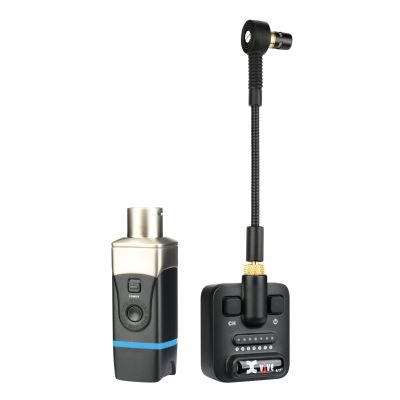
Dedicated systems for saxophone and trumpet combine a clip microphone, transmitter and receiver, eliminating an additional signal cable running from the instrument.

  • Plan the wireless frequency range together with existing systems.
  • Check battery life before the concert or rehearsal.
  • Attach the clip so that lacquer and mechanism are protected.
  • The transmitter must not obstruct finger movements or instrument balance.
  • Coordinate frequencies when several wireless links are used.
XVive U7 wireless microphone system with clip microphone for saxophone and trumpet
XVive U7 – a complete wireless solution with a detachable clip microphone for saxophone, trumpet and related brass instruments.
Directly to Suitable Solutions

22 Products for Wind Instruments, Wireless, Studio & Accessories

Wind Instrument Microphones
6 Products

Clip Microphones for Saxophone & Brass

9 Products

Stand Microphones for Live & Studio

Microphone & Wireless Worlds

Suitable Manufacturers at Musikhaus Korn

Soundcheck instead of Repairing Everything with EQ

Common Mistakes with Wind Instrument Microphones

Mistake 1

Aiming Only into the Saxophone Bell

The sound also emerges from the open tone holes.

A little more distance or a different clip orientation can create a more natural result.

Mistake 2

Miking a Trumpet Extremely Close and On-Axis

This can sound very direct and aggressive.

A small angle or more distance can change the tonal balance considerably.

Mistake 3

Not Checking Clip and Wireless Compatibility

Transmitters use different connectors and powering concepts.

Check exact electrical and mechanical compatibility before purchasing the combination.

Frequently Asked Questions about Wind Instrument Microphones

Answers for Stage, Rehearsal & Studio

Which Microphone Is Best for Saxophone?
A clip microphone is particularly practical for live performances because its position remains constant while the player moves. For studio recording, a small-diaphragm or dynamic microphone on a stand provides more freedom to capture the bell and tone holes together.
Which Microphone Is Suitable for Trumpet?
Suitable options include dynamic microphones that can handle high sound levels and dedicated condenser clip microphones. Some distance or a slightly off-axis position can produce a less sharp tonal character.
Clip Microphone or Stand for Trombone?
A clip provides maximum freedom of movement and stays outside the slide path. In the studio, a stand microphone with greater distance can create a more natural overall image.
Where Should a Microphone Be Positioned for Concert Flute?
A useful starting point is near the headjoint and key area, but not directly in the breath stream. Small changes in position can reduce wind noise and alter the balance between air and key sounds.
Does a Wind Instrument Microphone Need Phantom Power?
Many condenser microphones require a suitable power supply, while dynamic microphones normally do not. Some clip microphones require a separate powering adapter. Always check the exact product specification.
Can I Use a Vocal Microphone for Saxophone or Trumpet?
A suitable dynamic vocal microphone can work in principle. A dedicated instrument or clip microphone often offers more practical positioning and a construction better suited to the application.
Why Does My Wind Instrument Microphone Feed Back on Stage?
Feedback is created by the complete loop involving microphone, loudspeaker, room and amplification. Microphone direction, monitor position and required gain should therefore be optimised together.
Is a Wireless Microphone Worthwhile for Saxophone?
Wireless is particularly comfortable if you move significantly around the stage. For a fixed playing position or studio-only work, a wired system is usually simpler.
Can a Contact Microphone Replace a Wind Instrument Microphone?
Not automatically. Contact microphones intended for tuners mainly detect pitch through body vibration. Clip and stand microphones are the more usual solutions for PA and recording.
Which Microphone Is Suitable for a Wind Ensemble?
If the shared ensemble sound is the priority, one or more microphones positioned with some distance can be useful. Small-diaphragm stereo pairs allow a spatial recording without placing a separate microphone on every instrument.
Treat the Microphone as Part of the Instrument Sound

Microphones for Wind Instruments

Choosing the right microphone solution begins with the application. Clip microphones give saxophonists and brass players plenty of freedom on stage while keeping the distance to the sound source constant.

Microphones on stands allow more distance and therefore a more open representation of both instrument and room.

Position remains crucial: trumpet and trombone radiate strongly through the bell, while saxophone and clarinet also radiate through their tone holes.

Concert flutes need a microphone position that captures their sound without placing the capsule directly in the player's air stream.

Taking these differences into account often reduces the amount of EQ required and produces a more natural, controlled sound at the source.

More Buying Advice & Practical Knowledge

Choose Instruments, Microphones and Equipment Correctly

Further guidance covering musical instruments, studio equipment, DJ technology and event equipment can be found in the central Musikhaus Korn guide world.