Musikhaus Keks
Welcome!
Our cookies offer you a fast, relaxed and full-featured shopping experience. Some are necessary to operate the website and its functions. Others help us to improve our services. If you agree to this, simply consent to the use of cookies for preferences, statistics and marketing by clicking on "OK". Alternatively, you can deactivate individual cookies under "Customise cookies" or all cookies, except those required for the function of our website, under "Reject all".
Musikhaus Korn DJ Guide

2- or 4-Channel DJ Mixer? How to Choose the Right Mixer

Two turntables or four players? A compact 2-channel DJ mixer is completely sufficient for classic two-deck sets. A 4-channel mixer becomes worthwhile when additional media players, turntables, computers or performance devices need to remain connected at the same time. This guide explains when two channels are the better choice and when four channels genuinely provide more freedom for club, vinyl, DVS and hybrid setups.

Compare 2 and 4 channels directly Consider vinyl, DVS & club setups Buy only as many channels as you need
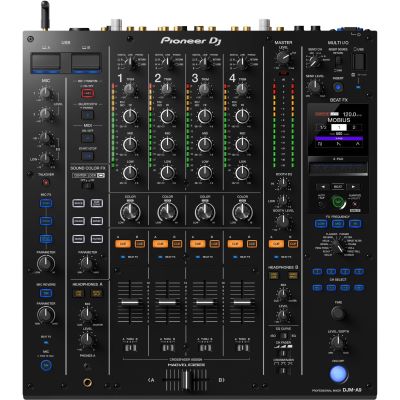
Pioneer DJ DJM-A9 professional four-channel club mixer

The key question: how many audio sources need to remain connected and independently controllable during your set? That determines the channel count you actually need.

The Quick Decision

Do You Need Two or Four Mixer Channels?

First count the audio sources that need to remain connected and independently controllable during the set. This immediately gives you the most sensible channel count.

Direct and Compact

Two Channels Are Enough for Two Main Decks

Two turntables, two media players or a classic DVS system fundamentally require only two mixer channels. Gain, EQ, filter, line faders, crossfader and Cue controls remain clearly arranged and easy to reach.

  • Classic two-deck mixing
  • Vinyl and DVS
  • Scratch and battle
  • Small home and mobile setups
More Sources

Four Channels Create Space for Expansion

Four players, two players plus two turntables or additional computer and performance signals can remain connected permanently. This makes the complete setup more flexible.

  • Club booths with several players
  • Vinyl and media players simultaneously
  • Back-to-back setups
  • Samplers and additional live devices

Remember: if your complete set consists of two sources, you do not need a 4-channel mixer simply because it looks more professional.

Full Concentration on Two Sources

When Is a 2-Channel DJ Mixer the Better Choice?

Classic DJ Workflow

Two Channels Cover Traditional Mixing Completely

A track plays on Channel 1 while you prepare Channel 2 through your headphones. Pitch, EQ, filters and faders then bring both sources together. No additional mixer channels are required for this workflow.

Vinyl & Scratch

A Reduced Surface Keeps Important Controls Close

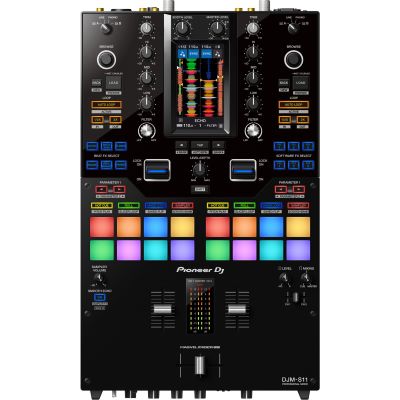
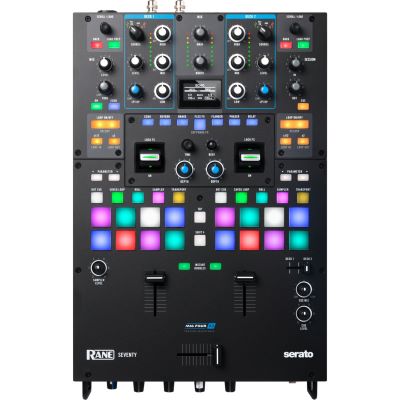
With two turntables positioned around a compact mixer, all important faders remain immediately accessible. Battle mixers therefore often use the available space for large performance pads, fast crossfaders and extensive DVS control rather than additional channel strips.

Quality Before Quantity

A High-End 2-Channel Mixer Can Offer More Than a Cheap 4-Channel Model

USB audio, digital effects, high-quality phono preamps, filters, dual USB or a professional crossfader can be more important than two additional channels. Compare the actual equipment rather than only the numbers.

Stay with two channels if you permanently work with two decks and do not require additional sources in parallel. This saves space, keeps the surface clear and can leave more of your budget for fader, audio and connection quality.

Four Sources Without Repatching

When Is a 4-Channel DJ Mixer Worth It?

Four Media Players

Give Every Player Its Own Channel

Additional tracks, loops or acapellas can remain prepared on their own players without replacing an existing deck.

Hybrid Booth

Two Players + Two Turntables

Digital music can remain connected through LINE while traditional vinyl stays ready on PHONO. All four sources can be used without repatching.

Back-to-Back

Make DJ Changeovers Easier

More channels make shared sets and DJ changeovers easier because several playback devices can stay connected simultaneously.

Live Hardware

Add Samplers and Additional Outputs

A sampler, drum machine or additional software output can use its own channel and be mixed like a conventional deck.

Do not confuse four channels with four decks: a 4-channel mixer provides four input channels. Whether your DJ software or players actually provide four decks is a separate question.

Count Before You Buy

Which Devices Need to Be Connected to the Mixer at the Same Time?

LINE

Media Players Need LINE Inputs

Independent DJ media players deliver line-level signals. Two players need two channels, while four independent players require four mixer channels if all of them are to remain separately controllable.

PHONO

Turntables Need Suitable PHONO Inputs

A traditional phono cartridge produces a significantly lower signal than a line-level player. Check how many proper Phono inputs the mixer provides if vinyl is part of your setup.

USB

Software Needs the Right USB Audio Paths

For DVS or several software decks, an integrated multichannel sound card can simplify cabling. Two USB computer connections are especially practical for back-to-back changeovers.

Traditional Vinyl or Digital Timecode

Two or Four Channels for Vinyl and DVS?

Two turntables need only two mixer channels. High-quality 2-channel mixers are therefore not a compromise for vinyl or battle DJs. Four channels become useful as soon as media players or other sources are also intended to remain permanently connected.

  • Two turntables: two good Phono channels are enough.
  • DVS: check compatible sound card and software.
  • Hybrid: plan additional LINE channels.
  • Scratch: give crossfader quality higher priority.
  • Club vinyl: consider Booth and Master outputs.
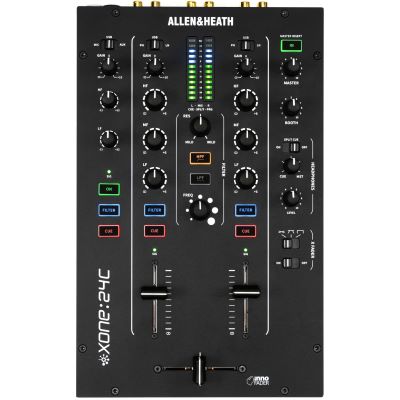
Allen and Heath Xone 24C two-channel hybrid DJ mixer for vinyl and DVS
Two turntables do not require four mixer channels. The quality of the Phono stages, crossfader and DVS routing can be more important than additional unused channels.
Reserve for a Complete Booth

Why Do Clubs Often Use 4-Channel Mixers?

A permanently installed booth must support more than the workflow of one individual DJ. Different artists should be able to use media players, turntables and additional equipment with as little repatching as possible.

Permanent Sources

Several Playback Devices Stay Connected

Four channels prevent unnecessary repatching and allow different DJs to choose between several connected sources.

Monitoring

Booth Monitoring Is Usually Integrated

Professional club mixers normally provide a separately adjustable Booth output for the DJ monitoring system.

Effects & Routing

Large Mixers Add More Than Channels

Digital club mixers often combine several channels with Beat effects, filters, USB audio and flexible routing.

Direct Buying Comparison

2- and 4-Channel DJ Mixers Compared

Feature 2-Channel Mixer 4-Channel Mixer
Classic 2-Deck Mixing Ideal Also possible
Overview Very clear More controls
Four Players Simultaneously No Ideal
2 Players + 2 Turntables Repatching or alternatives required Directly possible
Scratch / Battle Specialised models available Not usually the main focus
Club Booth Suitable for smaller setups Typical standard
Space Required More compact Larger
Expandability Limited High
Brand Worlds at Musikhaus Korn

Brands for 2- and 4-Channel DJ Mixers

Choose the Channel Count Sensibly

Typical Mistakes When Comparing 2- and 4-Channel Mixers

Mistake 1

Assuming Four Channels Are Automatically More Professional

A high-quality 2-channel battle or vinyl mixer can be significantly better suited to its intended application.

Mistake 2

Counting Only Inputs

Also check PHONO, LINE, USB, microphone inputs, Master, Booth and possible effect paths.

Mistake 3

Assuming DVS Compatibility

A USB connector does not automatically mean that every DVS application will work without an additional licence or configuration.

Mistake 4

Not Choosing the Crossfader for Your Playing Style

It is central to scratching. During long house or techno blends, the channel fader may be considerably more important.

Mistake 5

Underestimating Space Requirements

A 4-channel club mixer requires more working space and a correspondingly larger transport case.

Mistake 6

Buying Spare Channels Without a Concrete Plan

Expandability is useful, but unused controls do not make the mix better.

Frequently Asked Questions Before Buying

Answers About the Right Mixer Channel Count

Are Two Channels Enough for a Professional DJ?

Yes. If you work with two media players or two turntables, two channels are completely sufficient. Many professional battle and vinyl mixers are deliberately designed as 2-channel systems.

When Do I Really Need Four Mixer Channels?

When more than two audio sources need to remain connected and independently controllable at the same time – for example, four media players or two players plus two turntables.

Do I Need a 4-Channel Mixer for Four Software Decks?

Not necessarily. A DJ controller or software mixer can manage four virtual decks internally. Four physical mixer channels become important mainly when the signals need to reach an external mixer separately.

Which Is Better for Vinyl: Two or Four Channels?

Two good Phono channels are enough for two turntables. Four channels become useful if digital media players or additional playback sources also need to remain connected.

Why Do Clubs Often Use 4-Channel Mixers?

A club booth needs to support different DJs and different configurations. Four channels provide more reserve for players, turntables and changing sources.

Is a 2-Channel Mixer Better for Scratching?

Often yes, if it is a specialised battle mixer. These designs place greater emphasis on a fast crossfader, pads and DVS control than on additional channel strips.

Can I Connect Four Devices to a 2-Channel Mixer?

Some mixers provide several switchable inputs per channel. With a conventional 2-channel mixer, however, only two main channels can be mixed independently at the same time.

What Is More Important Than the Number of Channels?

Suitable Phono and Line inputs, fader quality, EQ and filter design, USB/DVS support plus Master and Booth outputs should always be considered as well.

Which Mixer Is Suitable for Mobile DJs?

The required channel count depends on the playback sources. For events, balanced Master outputs, Booth monitoring, microphone inputs and reliable operation are also important.

Is a 4-Channel Mixer Worth Buying as Reserve for Later?

Yes, if you already know that additional media players, turntables or live hardware will be added later. Without a specific expansion plan, a better-equipped 2-channel mixer can be the more sensible choice.

As Many Channels as Necessary, as Clear as Possible

2- or 4-Channel Mixer? Compare DJ Mixers

A 2-channel mixer is the direct solution for two turntables, two media players, battle DJing and many DVS setups. It keeps the workstation compact and concentrates operation on the two sources that are actually being mixed.

A 4-channel mixer becomes worthwhile when your setup grows beyond two sources. Four players, a combination of vinyl and digital playback or additional performance hardware can remain permanently connected. In club booths in particular, this creates flexibility for different DJs and workflows.

Channel count is still only the beginning. Then compare Phono and Line inputs, USB and DVS functions, crossfader, EQ and filters plus Master, Booth and effect paths. This helps you find not simply the larger mixer, but the mixer that actually suits your DJ setup.

More Buying Advice and Practical Knowledge

Discover More Musikhaus Korn Guides

From DJ mixers and media players to controllers, vinyl, DVS and complete club, mobile and performance setups, the central Musikhaus Korn guide contains further comparisons, buying advice and practical knowledge.