Judge Sub-Bass Reliably
808s, deep synthesizers and electronic kicks often extend below the useful operating range of compact nearfield monitors. A subwoofer makes this range audible in a controlled way.

A studio subwoofer should not simply make your setup sound bassier. Its job is to extend the frequency range of your studio monitors downwards in a controlled way. Especially for electronic music, hip-hop, pop, film sound and sound design, a correctly adjusted subwoofer can help you judge sub-bass, kicks and low-frequency effects more reliably. Room acoustics, position, crossover frequency, level and phase are decisive.
A subwoofer is not a compulsory part of a good home studio. If your existing monitors already reproduce the bass range relevant to your work reliably and you can judge that range accurately in your room, an additional low-frequency system may not be necessary.
808s, deep synthesizers and electronic kicks often extend below the useful operating range of compact nearfield monitors. A subwoofer makes this range audible in a controlled way.
Film sound, games and sound design can contain very low effects and LFE information. Suitable bass management becomes particularly useful here.
Compact nearfield monitors can remain optimised for your short listening distance while a separate subwoofer adds the missing deep bass.
If the bass already booms strongly or individual notes disappear, improve the listening position and room acoustics first. Additional low-frequency energy can make existing problems even more obvious.
A studio subwoofer is useful when it gives you information that your main monitors cannot reproduce reliably. It is not useful when it is merely turned up to make listening more impressive.
In a correctly adjusted 2.1 system, the subwoofer and main monitors do not operate independently. They divide the frequency range and should behave like one coherent monitoring system at the listening position.
The sub reproduces frequencies below a defined transition region and therefore extends the lower frequency limit of the complete monitoring system.
If the system provides a high-pass filter for the satellites, the main monitors no longer need to reproduce the deepest frequencies below the transition fully.
Excessive subwoofer level, an unsuitable crossover or incorrect phase alignment can produce unreliable bass even when every individual loudspeaker is high quality.
Bass management divides the audio signal between the main monitors and the subwoofer. Depending on the system, this can take place inside the subwoofer, in a monitor controller, digitally via DSP or within another dedicated studio solution.
Switching it on should make the frequency range more complete towards the bottom. The entire mix should not suddenly sound fundamentally bassier.
A good studio subwoofer complements the bass – it does not dominate it.
The crossover frequency defines the region in which the subwoofer and main monitors hand over their respective tasks. The appropriate setting depends on the main monitors and on the bass-management system being used.
Smaller woofers may benefit from being relieved earlier so they no longer have to reproduce the deepest bass frequencies.
If your monitors already reproduce bass cleanly and deeply, the subwoofer can take over only the actual deep-bass region.
With monitor and subwoofer systems designed to work together, first use the recommended crossover because it takes the loudspeakers and filter characteristics into account.
The correct setting is the one that produces the smoothest transition at your listening position without a gap or excessive boost between the subwoofer and the main monitors.
Around the crossover region, the main monitors and subwoofer can reproduce some of the same frequencies. If those signals combine unfavourably, bass can disappear precisely in that transition range.
Many studio subwoofers provide a 0° / 180° switch, while other models offer continuously variable phase adjustment or automatic calibration.
Compare the available settings from the actual listening position and choose the one that produces the more even transition.
The best setting also depends on the path lengths between subwoofer, main monitors and your listening position. If the sub is moved significantly, check the phase again.
The subwoofer does not necessarily need to stand exactly between the main monitors. Low frequencies allow more positional freedom, but the room has a very strong influence on which location produces the most even bass at the listening position.
A position along the front wall near the plane of the main monitors is a sensible starting point for many studio setups.
A slightly off-centre position can excite room modes differently and may produce a more even response at the listening position.
Move the subwoofer in small increments and always listen or measure from the actual mixing position.
After every significant positional change, recheck level, crossover and phase.
Room dimensions create resonances and cancellations. This can make the same low-frequency signal much louder or quieter depending on where you listen.
A corner can raise bass level substantially. This may sometimes be useful, but it does not automatically produce the most accurate response.
Calibration can reduce peaks effectively. A deep acoustic cancellation cannot normally be repaired sensibly simply by applying more electrical level.
If a bass note almost disappears at the mixing position but becomes extremely loud a metre away, the subwoofer is not automatically defective. The more likely cause is an unfavourable combination of room and listening position.
With subwoofers that provide stereo inputs and outputs, the left and right signals first run from the audio interface to the subwoofer and then continue to the main monitors. Internal bass management can divide the frequency range between both parts of the system.
Larger studios can operate the subwoofer through a monitor controller or separate output. A bypass function is particularly useful because it lets you compare the same mix quickly with and without the low-frequency extension.
A matched system is particularly practical when you do not want to combine different monitor and subwoofer series yourself.
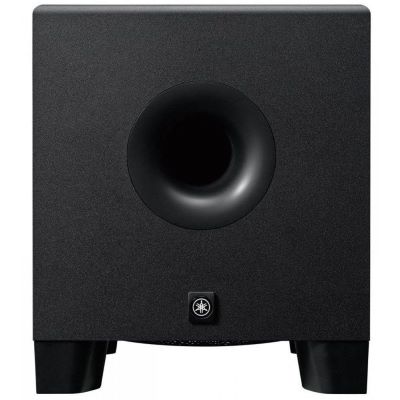
Two HS8 nearfield monitors combined with the matching HS8S for a complete stereo monitoring system with extended deep bass.
White HS8 monitors combined with the HS8S for a complete active monitoring solution with dedicated low-frequency extension.
Compact T5V nearfield monitors with a separate Sub8 low-frequency extension for home and project studios.
Choose the main monitors according to listening distance, room and required bass extension before selecting the subwoofer.
Matched monitor and subwoofer combinations simplify the selection of compatible components.
Correct height and symmetrical placement of the main monitors remain essential when adding a subwoofer.
Central volume control and subwoofer bypass make comparison between full-range and reduced monitoring particularly convenient.






An exaggerated monitoring system often causes you to mix too little bass because your studio reproduces more deep bass than is actually present in the mix.
The subwoofer can extend unnecessarily far into the lower midrange and become easier to perceive as a separate sound source.
Incorrect phase alignment can cancel bass at the crossover even though both the monitors and subwoofer sound powerful when listened to individually.
If a frequency disappears because of acoustic cancellation, turning the subwoofer up usually does not solve the problem. Position and room acoustics need to be checked.
Not necessarily. If your studio monitors reproduce the bass range relevant to your work reliably, you can work professionally without a subwoofer. It becomes particularly useful when important sub-bass information lies below the useful range of your main monitors.
Electronic music, hip-hop, pop with deep synthesizers, film sound and sound design often benefit directly. Acoustic productions can also benefit when low bass instruments need to be judged accurately.
This depends on your main monitors and the bass-management design. Start with the manufacturer's recommendation. The aim is a smooth transition without a gap or an exaggerated frequency range.
A typical 0° / 180° switch changes the polarity of the subwoofer relative to the main monitors. Around the crossover region, one setting may produce a more even bass response at the listening position than the other.
No. Low frequencies allow more positional freedom. What matters is the bass response at the listening position. A position along the front wall is a useful starting point.
Yes, provided that level, position and room behaviour are adjusted carefully. Controlled bass reproduction is often more challenging in a small room, however.
Not inherently. Driver size, enclosure, amplifier power, frequency response, listening distance and room must be considered together. A compact subwoofer can be the more suitable choice for a small workstation.
It should be calibrated so that the complete system produces a balanced frequency response. The subwoofer should not stand out as an additional boosted bass source.
Yes, provided the connections, frequency ranges and bass-management options can be combined sensibly. A matched manufacturer system can make the initial setup easier.
It allows you to compare your mix quickly with and without deep-bass extension. This is useful for mixing decisions and for checking translation to smaller playback systems.
It can reduce peaks and certain room-related problems. An unfavourable listening position or a deep acoustic cancellation should first be improved through positioning and room planning.
A studio subwoofer is useful when your existing monitors cannot reproduce the deep-bass range relevant to your work reliably. It extends the monitoring system downwards and, depending on the bass-management design, can also relieve the main monitors of the lowest frequencies. This is particularly useful for electronic music, hip-hop, film sound and sound design.
The quality of the result depends much more on integration than on maximum output. Level, crossover frequency, phase and position must be adjusted so that the subwoofer and studio monitors behave like one coherent system at the listening position.
Begin with a sensible physical position, set the crossover to suit your main monitors and then adjust the subwoofer level. Check phase afterwards and compare several familiar reference tracks. Only after these fundamental settings are correct should DSP or automatic room correction be used for further optimisation.
The best studio subwoofer is therefore not automatically the largest model. A compact 6.5- or 8-inch system can be better suited to a short desktop listening distance, whereas larger 10-inch and reference systems provide advantages when greater level reserves and larger control rooms are involved.
Discover further Musikhaus Korn guides covering studio monitors, audio interfaces, microphones, studio headphones, recording and complete studio technology.