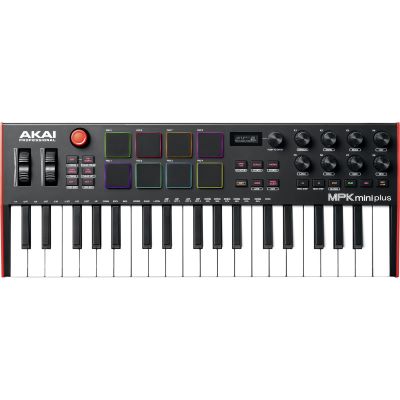
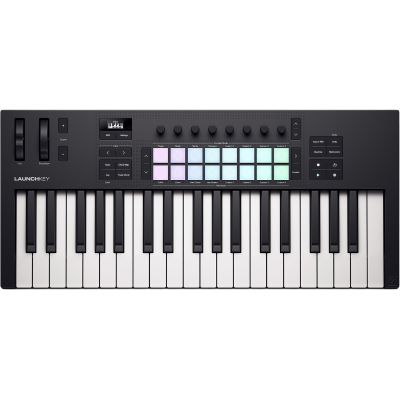
25 to 37 Keys with Pads
Compact controllers fit on small desks and into mobile setups. Pads are useful for drums, samples and clip-oriented production. Octave buttons extend the otherwise limited keyboard range.
25, 37, 49, 61 or 88 keys? Mini keys or hammer action? Do you need drum pads, faders, aftertouch or a classic MIDI output? The right MIDI keyboard depends not only on the space available but above all on whether you produce beats, play virtual synthesizers, arrange orchestral music or want to control a hardware synthesizer.
A beatmaker needs different controls from a pianist or film composer. First decide what you will do most often with the controller. Once that is clear, the required size becomes much easier to determine.
Compact controllers fit on small desks and into mobile setups. Pads are useful for drums, samples and clip-oriented production. Octave buttons extend the otherwise limited keyboard range.
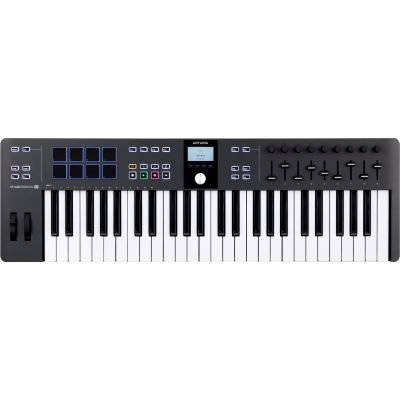
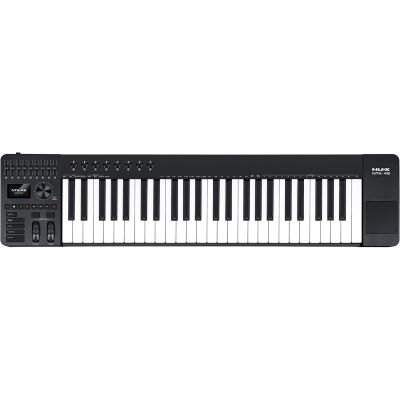
Four octaves provide plenty of space for chords, bass, melodies and synth lines without taking over the entire studio desk. For many producers, 49 keys are therefore a very flexible middle ground.
Five octaves make two-handed playing, more complex chords, splits and larger virtual instruments easier, while the controller remains more portable than a full 88-key master keyboard.
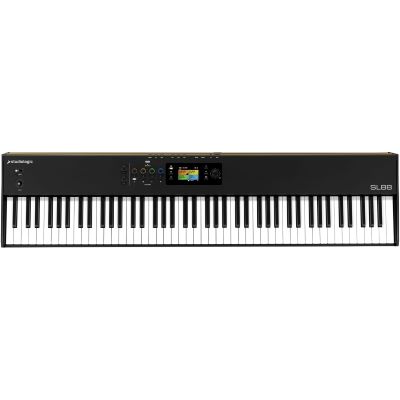
For virtual grand pianos, orchestral libraries and pianist-oriented recording, playing feel takes priority. Weighted keys are normally more important here than a large number of drum pads.
MIDI can transmit information such as which key you played, how strongly it was struck and which knobs, faders or other controllers you moved. A DAW, virtual instrument or compatible external hardware can respond to this data.
Pressing a key on a controller does not automatically create an audible piano or synthesizer sound. The actual sound usually comes from software or an external sound generator.
Master keyboards are primarily input devices. There are individual special models with integrated sounds, but with a classic MIDI keyboard the computer, smartphone, tablet or external hardware normally provides the sound generation.
With many controllers, one USB cable to the computer is enough. It transmits MIDI data and frequently supplies power to the keyboard at the same time. For external hardware, DIN MIDI, TRS MIDI or CV/Gate can provide additional options.
Mini keys are practical for beatmaking, synth lines and mobile use. Pianists and players with larger hands should try them before buying because their width and leverage feel significantly different from full-size keys.
Both sizes allow chords and two-handed parts without necessarily requiring the space of a complete piano. 61 keys give you additional freedom for splits and orchestral setups.
They are ideal for piano playing. A beatmaker, however, loses valuable desk space if the controller is mainly used for drums and short synth lines.
| Keyboard | Playing Feel | Especially Suitable For | Keep in Mind |
|---|---|---|---|
| Mini Keys | Small and light | Mobile setups, beats, small studios | Less piano-like |
| Synth-Style | Fast and light | Synthesizers, pop, electronic music | Less piano resistance |
| Semi-Weighted | Medium resistance | Versatile studio keyboards | Not a full hammer-action feel |
| Hammer Action | Piano-like and heavier | Piano, orchestral work, film scoring | Larger and heavier |
Velocity-sensitive pads work well for kick, snare, hi-hat, samples and clips. For hip-hop, electronic music and finger drumming, they can be more useful than additional keys.
Faders can control mixer channels, orchestral dynamics, virtual drawbars and automation. Nine faders are particularly convenient for typical groups of eight channels plus a master control.
Filters, resonance, plug-in parameters and effects can be changed more directly. Good automatic software mapping can save a considerable amount of manual assignment work.
After the initial key strike, additional pressure is transmitted as control information. It can be used for vibrato, filters or other modulation when both controller and sound generator support the desired function.
Many controllers provide transport buttons for Record, Stop, Play and navigation. More extensive models can control the mixer, plug-ins, virtual instruments and browser directly. The important point is how deeply the controller actually integrates with your preferred software.
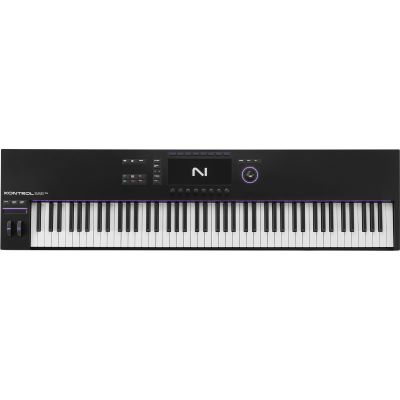
Specialised controllers can be useful. Novation's FL Keys series, for example, concentrates on an FL Studio-oriented workflow, while Native Instruments KONTROL keyboards are particularly closely integrated with compatible software instruments.
This is the standard route to a computer. One cable can transmit MIDI data and frequently power the controller at the same time. A direct connection between two USB devices, however, normally requires a suitable USB host.
Particularly useful for hardware synthesizers, desktop modules and other traditional MIDI equipment because the connection can be made without a computer.
Compact devices sometimes use 3.5 mm jack connectors for MIDI. The adapter and wiring type must match the specific equipment. Do not connect devices solely because the plug shape appears to fit.
A sustain pedal is important for piano parts. An expression pedal can control volume, orchestral dynamics or other parameters while you continue playing.
| Size | Strength | Typical Workflow | Recommended Extras |
|---|---|---|---|
| 25–37 | Mobile and compact | Beatmaking, synth lines, mobile production | Pads, arpeggiator, chord mode |
| 49 | Balanced all-rounder | Home studio, pop, electronic production | Pads, faders, encoders |
| 61–73 | Large playing range | Songwriting, arrangement, live use | Splits, aftertouch, DAW control |
| 88 | Full piano range | Piano, film, orchestra, composition | Hammer action, pedals, expression |
Use the number of keys as a first rough filter. Within each group, compare keyboard feel, pads, faders, aftertouch, DAW integration and hardware connections.
Virtual instruments require a compatible computer or suitable mobile device together with appropriate music software.
An audio interface is not required simply to make USB MIDI work. It becomes important when microphones, instruments, professional headphones or studio monitors are integrated into the same setup.
Headphones are particularly practical for production in small rooms. They are connected to the computer or, preferably, to a suitable audio output or audio interface.
Additional MIDI inputs and outputs can be useful when several external synthesizers are involved. A MIDI interface keeps larger hardware setups more organised.
An 88-key controller is impressive, but for beatmaking on a small desk it is frequently unnecessary. Measure the available workspace before buying.
You physically interact with a controller every day. Keyboard feel, pads, knobs and software integration can be more important than ten additional keys.
If you later want to control a desktop synthesizer without a computer, make sure the controller provides a suitable MIDI output. USB alone does not solve every hardware-routing situation.
Most MIDI keyboards need software or external hardware before an actual instrument sound can be heard.
Play the same chords, bass lines and melodies on each size and then operate the software functions you use most often. Also check the controller's actual width on your studio desk. A controller that can remain permanently set up is often used more frequently than a larger model that has to be packed away after every session.
Put MIDI keyboards, conventional keyboards, pianos and synthesizers into context as different keyboard-instrument concepts.
Discover hardware sound generators that can be played and controlled from a MIDI or master keyboard.
Compare pads, faders, encoders and other specialised control elements without the main focus being a traditional musical keyboard.
Combine audio interface, headphones, monitors, software and MIDI hardware into a complete music-production workspace.
When choosing a MIDI keyboard, the number of keys is the easiest first filter. Compact controllers with 25 to 37 keys are suitable for beatmaking and mobile production, 49 keys form a flexible middle ground and 61 keys provide plenty of room for songwriting and arrangements. Piano and orchestral players often benefit from an 88-key master keyboard with weighted hammer action.
The controls are the next deciding factor. Pads support drum and sample workflows, faders simplify mixing and orchestral automation, encoders control plug-ins and aftertouch adds another level of musical expression. USB MIDI is particularly convenient for computer production, while traditional MIDI outputs make direct control of external synthesizers easier. The result is a controller setup that not only works technically but actively speeds up your musical workflow.
From musical instruments and home-studio equipment to DJ and event technology, find more step-by-step buying guidance in the central Musikhaus Korn guide.