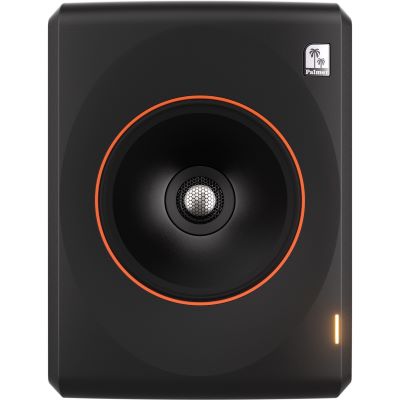
Compact Nearfield Monitors
Compact nearfield monitors are ideal here. They require little space and are designed to provide a high proportion of direct sound at short distances.

Nearfield monitors are positioned relatively close to your listening position, increasing the proportion of direct sound and reducing the relative influence of the room. Midfield monitors are designed for greater listening distances and usually provide higher level reserves. However, woofer size alone does not define the monitor type: an 8-inch monitor can still be a nearfield model, while a sophisticated 3-way system may be designed specifically for midfield monitoring.
First measure the distance between your planned listening position and the loudspeakers. This value is more useful for your decision than a general rule based purely on room size or woofer diameter.
Compact nearfield monitors are ideal here. They require little space and are designed to provide a high proportion of direct sound at short distances.
This is the classic application range for nearfield monitors. 5-, 6- and 7-inch systems provide a particularly wide range of useful choices.
High-performance 7- and 8-inch nearfield systems or compact 3-way monitors can provide greater bass extension and level reserves.
Midfield monitors become increasingly interesting at greater distances. They can provide a larger workstation with more dynamics, bass extension and listening headroom.
If you sit directly at a studio desk, nearfield monitoring is almost always the first place to look. If your listening distance becomes significantly greater and several people need to monitor reliably at higher levels, comparing midfield systems becomes worthwhile.
A nearfield monitor is used relatively close to the listening position. A large proportion of the direct loudspeaker sound reaches your ears before strong reflections from walls, ceiling and desk arrive.
A midfield monitor is designed for greater listening distances and often provides higher level reserves. This allows larger control rooms or several people in front of a mixing position to be monitored more effectively.
Powerful monitors can operate in the larger nearfield or smaller midfield. The manufacturer's recommendation for the specific model is therefore particularly important.
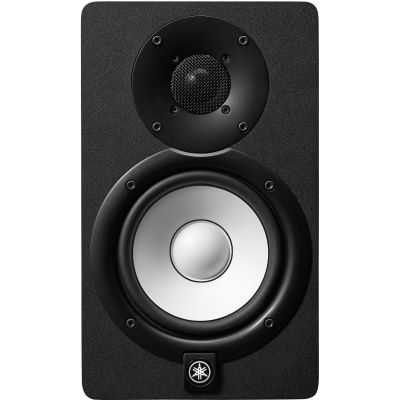
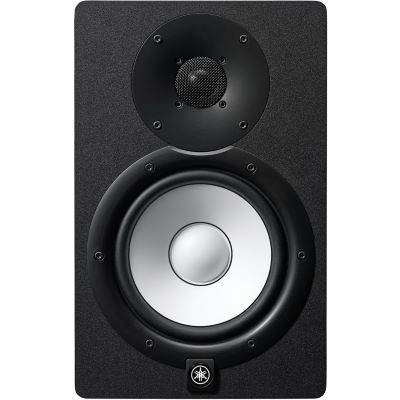
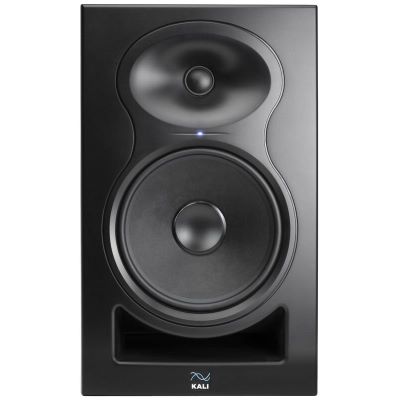
No. The Yamaha HS8 and Kali Audio IN-8 2nd Wave are good counterexamples. Both use 8-inch woofers but are designed and used as nearfield monitors. Woofer size tells you something about the loudspeaker concept, but it does not automatically define the intended listening distance.
No. A 3-way system divides bass, midrange and treble between different driver sections. Compact 3-way nearfield monitors exist alongside large midfield and main-monitor systems.
Nearfield or midfield primarily describes the listening situation – not the number of inches printed on the specification sheet.
A loudspeaker must produce a balanced sound image, sufficient level and a stable stereo image at your actual seating position.
When the monitors are positioned close to you, the direct sound is comparatively dominant over the room. This makes nearfield monitoring particularly attractive for smaller home studios and rooms without comprehensive acoustic treatment.
As the distance increases, the direct level at the listening position decreases and the room becomes more influential. A midfield system therefore typically provides greater power reserves and dispersion designed for the longer distance.
This does not mean that midfield monitors are automatically “better”. In a small bedroom studio, a compact nearfield monitor may provide much more reliable monitoring.
| Characteristic | Nearfield | Midfield |
|---|---|---|
| Listening Distance | Short to approximately 2 m | Greater distance |
| Typical Application | Desktop, home studio and project studio | Larger control room, mixing and mastering |
| Relative Room Influence | Lower at short distance | Acoustically increasingly relevant |
| Level Reserves | Designed for short distances | Usually significantly higher |
| Low-Frequency Extension | Model-dependent | Often extended |
| Driver Configuration | 2-way and 3-way possible | Often 3-way or larger |
| Space Requirement | Compact to medium | Usually greater |
| Room Acoustics | Important | Particularly important |
The woofer and tweeter divide the frequency range between them. This allows compact cabinets and is therefore extremely common in nearfield monitoring. Even powerful 7- or 8-inch systems can remain 2-way nearfield monitors.
An additional midrange driver reduces the workload on the bass and high-frequency drivers. This can be especially useful for voices, guitars and other midrange-rich signals and can provide greater level reserves in larger systems.
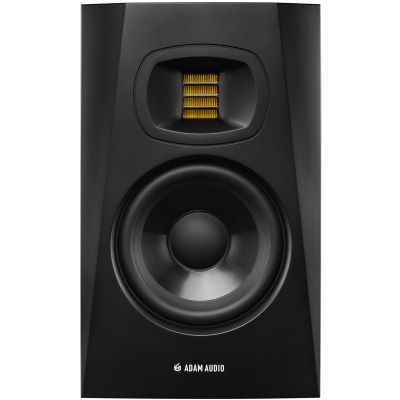
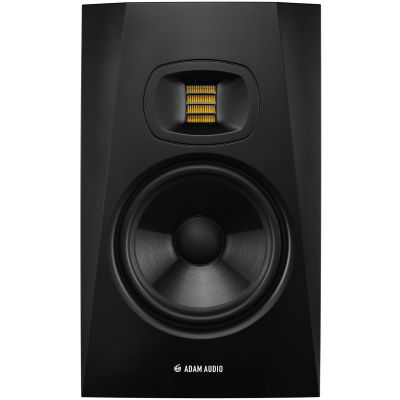
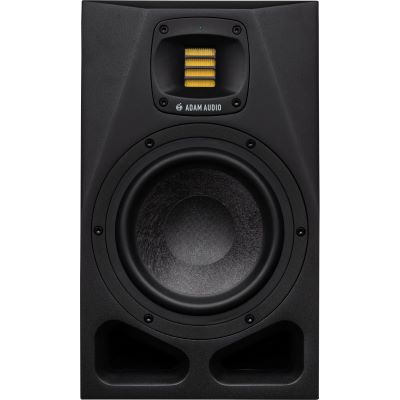
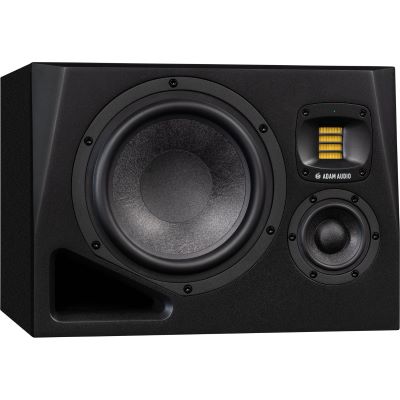
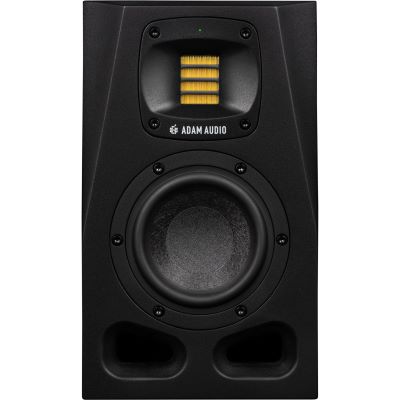
The Kali Audio IN-8 2nd Wave is a good example of a 3-way nearfield monitor. The ADAM Audio A77H, by contrast, is explicitly designed as a 3-way midfield monitor.
A midfield system does not simply require more square metres. It needs a workstation where loudspeakers and the listening position can be arranged with sufficient distance and as symmetrically as possible.
If the monitor is positioned directly behind your computer screen, you will hardly benefit from the advantages of a midfield system. The room should permit a clearly greater loudspeaker distance.
Powerful midfield systems often extend very low in frequency. Room modes and boundaries therefore need to be considered carefully when positioning the monitors and planning acoustic treatment.
Greater listening distances increase the influence of side-wall reflections. A symmetrical environment around the listening position and both monitors supports a stable stereo image.
In a compact untreated room, moving the loudspeakers farther away can increase the relative influence of reflections. A well-positioned nearfield setup can therefore provide the more reliable reference.
This group demonstrates particularly clearly why woofer size and monitor category must not be treated as the same thing.
These systems are intended for larger listening situations or deliberately operate in the transition between larger nearfield and midfield monitoring.
A powerful nearfield or midfield monitor can extend the low-frequency range significantly without requiring an additional subwoofer. This keeps the monitoring signal path comparatively straightforward.
Compact main monitors can be chosen specifically for the listening distance while a separate studio subwoofer adds deep bass. Crossover frequency, phase, level and subwoofer position then need to be adjusted carefully.
Bring loudspeakers to the correct height and provide a defined position independently from the studio desk.
Particularly useful when switching between nearfield, midfield, a subwoofer and an additional reference monitoring system.
Provide balanced outputs for connecting active studio monitors to your recording and mixing system.
Add a second monitoring reference without additional room influence and help you check details independently from your loudspeaker system.







A nearfield monitor is designed for relatively short listening distances. This provides a high proportion of direct sound and reduces the relative influence of the room.
Midfield monitors are designed for greater listening distances and often provide higher level reserves. They are particularly common in larger studio control rooms.
There is no hard boundary. As a general orientation, classic nearfield listening is often below approximately two metres. Beyond this, midfield systems become increasingly interesting. The manufacturer's recommendation for the specific monitor remains decisive.
No. The Yamaha HS8 and Kali Audio IN-8 are examples of 8-inch systems designed as nearfield monitors. Woofer size alone does not define the intended listening distance.
Usually not. If you sit approximately one metre from your loudspeakers, nearfield monitors normally suit the workstation better. Midfield monitoring becomes more interesting as the listening distance increases.
Not inherently. They solve a different monitoring task. At a short listening distance, a high-quality nearfield monitor can be more precise and useful than a large midfield system.
It normally requires more space for both the loudspeaker distance and the listening position. The room should also be acoustically controlled because reflections contribute more strongly to the perceived sound at greater distances.
3-way systems are common in midfield monitoring but are not mandatory. The additional midrange driver can reduce the workload on the bass and treble systems and support high level reserves.
Yes. Professional studios often use several monitoring systems. A monitor controller allows quick comparison between nearfield monitors, a larger reference system and, where applicable, a subwoofer.
Position them symmetrically relative to the listening position, observe the listening distance recommended by the manufacturer and align the acoustic axis correctly. With large systems, follow the manufacturer's instructions for vertical or horizontal positioning particularly carefully.
Nearfield monitors are designed for short listening distances and are therefore the typical choice for home studios, desktop setups and many project studios. At a listening distance of approximately one to one and a half metres, they provide a high proportion of direct sound and reduce the relative influence of the room.
Midfield monitors become more interesting as listening distance, room dimensions and required sound pressure increase. They often provide greater low-frequency extension, dynamics and level reserves and are particularly attractive for larger control rooms and professional mixing and mastering positions.
Never make the decision based on woofer size alone. 7- and 8-inch systems can still be designed as nearfield monitors. The correct order is therefore to determine the listening distance, assess the room, define the required low-frequency extension and then select the specific monitor concept recommended by the manufacturer.
Discover more Musikhaus Korn guides covering studio monitors, audio interfaces, microphones, headphones, recording and complete studio technology.