Musikhaus Keks
Welcome!
Our cookies offer you a fast, relaxed and full-featured shopping experience. Some are necessary to operate the website and its functions. Others help us to improve our services. If you agree to this, simply consent to the use of cookies for preferences, statistics and marketing by clicking on "OK". Alternatively, you can deactivate individual cookies under "Customise cookies" or all cookies, except those required for the function of our website, under "Reject all".
Musikhaus Korn Buying Guide

Stage Box & Digital Multicore

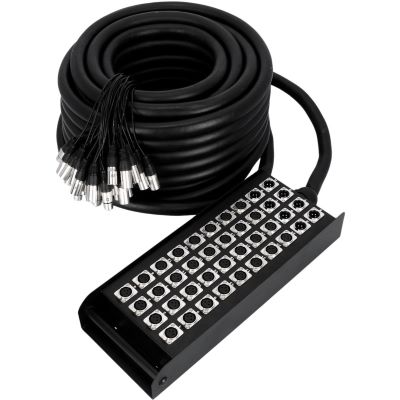
Many microphones are on stage while the mixing console is 30, 50 or 80 metres away at front of house. This is exactly where stage boxes and multicores come into play. A traditional analog multicore carries every audio channel through its own conductor pair. A digital stage box converts the signals on stage and transports numerous channels to the mixer through a digital connection.

Analog & digital explained Dante, DX, dSnake & SLink classified FOH, monitoring & network considered
The quick decision

When Do You Need an Analog Multicore and When a Digital Stage Box?

Analog

For Universal and Manageable Setups

A classic analog multicore does not depend on a specific digital mixer protocol. Microphones connect on stage and their analog signals travel directly to the mixing console.

  • No digital protocol required
  • Compatible with many analog mixers
  • Simple troubleshooting for individual channels
  • Heavier and bulkier as channel count increases
Digital

For Many Channels and Modern Digital Mixers

The stage box contains microphone preamps and converters. Numerous audio channels can then reach the mixing console through a single digital connection.

  • Less heavy copper cabling to FOH
  • Preamps can often be controlled remotely
  • Monitor outputs are available directly on stage
  • Protocol compatibility must be checked
Audio over CAT

CAT Cable Can Also Carry Analog Audio

Passive CAT adapters can carry several balanced analog signals over the twisted pairs of a network cable. This may look like digital technology, but it is not Dante, AES50 or IP network audio.

  • Compact alternative for a small number of channels
  • No A/D conversion required
  • Adapters are required at both ends
  • Pin assignment and standard must match

Practical starting point for bands: a compatible 16-input / 8-output digital stage box is particularly useful for many setups. Sixteen microphone or line signals can travel to the mixer while eight returns can feed wedges, in-ear systems or other stage destinations.

Keep the terminology clear

What Are a Stage Box, Multicore and Digital Multicore?

Stage Box

The Connection Point on Stage

Microphones, DI boxes and other sources are connected at the stage box. A stage box can be a purely passive analog device or an active digital unit containing preamps and converters.

Analog Multicore

One Shielded Pair for Every Audio Channel

In a traditional analog multicore, every channel has its own shielded conductor pair. Return paths from the console back to the stage can also be integrated into the same cable loom.

Digital Multicore

Stage Box + Digital Link + Compatible Mixer

The term normally describes the complete system that transports multiple digital audio channels between a digital stage box and the mixing console. The connection may use a proprietary point-to-point protocol or a network-based audio system.

Two different signal paths

Analog Multicore and Digital Stage Box Compared

Feature Analog Multicore Digital Multicore
Transmission One analog conductor path per channel Many digital channels over a small number of data links
Microphone Preamps Normally located in the mixer Usually located in the stage box
Gain Control Directly on the mixing console Remote control on compatible systems
FOH Cable Large multipair cable CAT, EtherCON or another digital connection
Power on Stage Passive stage box normally needs no mains power Active digital stage box requires power
Expansion Additional physical cables Highly flexible depending on model and protocol
Compatibility Very universal Protocol and mixer must match
Redundancy Additional analog lines Available on suitable digital systems
The connector alone does not determine compatibility

Understanding Dante, SLink, dSnake, DX, GX and AES50

Many digital live-audio systems use CAT cables and RJ45 or EtherCON connectors. They can nevertheless carry completely different and incompatible transmission protocols.

Dante

A Network-Based Audio System

Dante transports multichannel audio over an Ethernet network. Suitable devices can be connected through appropriate network infrastructure and audio channels can be routed throughout the network.

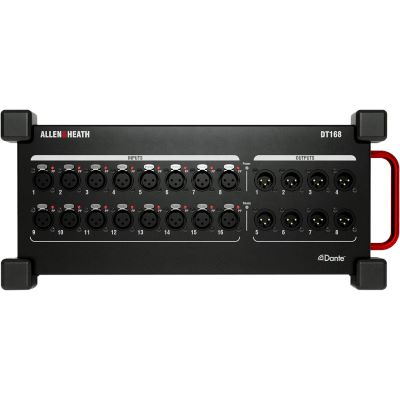
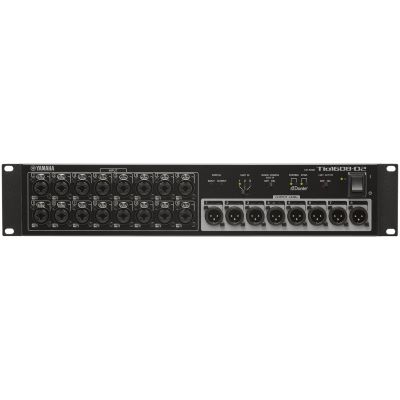
Examples on this page include the Allen & Heath DT168 and Yamaha Tio1608-D2.

Allen & Heath

SLink, dSnake, DX and GX

SLink is used on compatible Allen & Heath consoles to connect different remote-I/O families. dSnake works at 48 kHz, while DX and GX systems operate at 96 kHz.

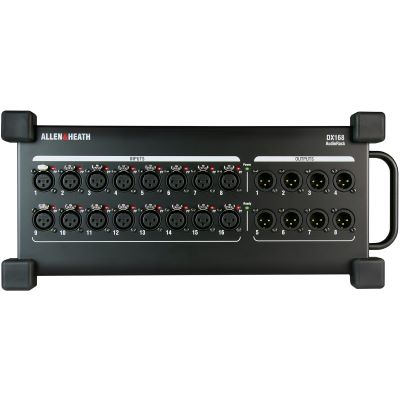
A DX168 provides 16 inputs and 8 outputs, while a GX4816 provides substantially more stage I/O for larger systems.

AES50

CAT Cable Does Not Make It Dante

AES50 is also used by several professional digital live systems and can run over CAT cabling. It is nevertheless not interchangeable with Dante, DX or dSnake simply because the connectors look similar.

Before purchasing: check the mixer, stage box, protocol, supported sample rate, maximum channel count and permitted cable length as one complete system.

The cable is part of the digital system

Which CAT or EtherCON Cable Do You Need?

Always use at least the cable category, shielding specification and maximum length required by the manufacturer of the audio system. Professional EtherCON connections additionally protect the mechanically sensitive RJ45 connection.

  • Check the required CAT5e, CAT6 or CAT6a category
  • Use robust and flexible cable for mobile applications
  • Use shielded cable where required by the system
  • Fully and neatly unwind long cable reels before operation
  • Protect data cables against footsteps and crushing
  • Carry a tested spare cable for important productions
STAGG CAT6 75 metre network cable on a cable reel with Neutrik EtherCON connectors
Long CAT connections for professional audio systems should be robust, protected and approved for the specific protocol in use.

Not every Audio-over-CAT system is digital: passive CATBOX and Audio-over-CAT adapters can simply distribute several analog audio channels across the twisted pairs of a CAT cable. No IP network, Dante controller or digital converter is required.

Create an I/O list before buying

How Many Inputs and Outputs Does Your Stage Box Need?

Small Band

16 Inputs Can Be a Practical Starting Point

Two or three vocals, guitars, bass and reduced drum miking can often fit into a 16-channel stage box.

Full Rock Band

20 or More Inputs Can Be Reached Quickly

Eight drum channels, several vocals, guitars, bass and a stereo keyboard can already require more than twenty stage inputs.

Monitoring

Do Not Forget the Returns

Every wedge or in-ear mix needs a suitable output on stage. Eight returns therefore become valuable surprisingly quickly in a complete band setup.

Reserve

Leave Inputs and Outputs Free

Two to four spare inputs plus several spare outputs make guest musicians, talkback and later system expansion much easier.

Count both directions: the input count determines how many sources can reach the mixer. The return count determines how many independent monitor, in-ear and other stage signals can travel back from the mixer.

One cable can carry many channels

Redundancy and Reliability with Digital Multicores

The major advantage of digital multicores – transporting many channels over only a few cables – is also a reason to protect the central connection carefully.

Spare Cable

Carry a Tested Second Data Cable

If one central cable carries dozens of channels, a single damaged connection can affect a large part of the show. A prepared spare cable is therefore useful for important events.

Primary / Secondary

Use Redundant Ports Where Supported

Some Dante and other professional stage boxes provide redundant network connections. The exact redundancy mode depends on the system and should be configured according to the manufacturer.

Power

Protect the Stage Box Power Supply

A digital stage box needs mains power. Power distribution, power cables and their physical route should therefore be planned as carefully as the digital data connection.

The complete signal path

Product Categories Around the Stage Box

Stage I/O

Stage Boxes & Multicores

Analog and digital connections between stage and FOH.

Control

Digital Mixers

Control remote I/O, routing and monitoring.

Digital Link

Network Cables

CAT and EtherCON connections for compatible audio systems.

FOH

Mixer Cases

Protect the console and related accessories during transport.

Monitoring

In-Ear Monitoring

Use stage-box outputs for personal monitor mixes.

Wedges

Active Stage Monitors

Feed monitor paths directly from stage outputs.

Connections

Cables & Connectors

XLR, CAT, power and adapter connections for complete systems.

Protection

Racks & Cases

Protect stage boxes, wireless equipment and power distribution.

23 verified product examples

Stage Boxes, Multicores, CAT Adapters and Matching Digital Mixers

The selection follows the system types used on the current German source page. Product images use the relevant Musikhaus Korn item numbers. Prices and stock levels are intentionally not hard-coded into this landing page.

6 Digital Stage Boxes & Remote-I/O Systems

Digital I/O for Modern Live Systems

Internal brand worlds

Manufacturers for Stage Boxes, Multicores and Digital Signal Paths

Avoid compatibility problems

Seven Common Digital Multicore Mistakes

Mistake 01

Looking Only at the RJ45 Connector

The same connector can carry completely different and incompatible audio protocols.

Mistake 02

Planning Too Few Returns

Wedges and in-ear systems need additional outputs back on stage.

Mistake 03

Using an Unsuitable CAT Cable

Category, shielding, length and connector type must comply with the manufacturer specification.

Mistake 04

Confusing Dante with Point-to-Point Audio

Not every digital CAT connection may be routed through an ordinary Ethernet switch.

Mistake 05

Forgetting Stage Power

Active digital stage boxes require reliable mains power directly at the stage.

Mistake 06

Carrying No Spare Data Cable

One damaged central digital cable can affect many audio channels at the same time.

Mistake 07

Buying Without Checking the Complete System

Check sample rate, protocol, firmware, channel count, cable length and preamp control before purchasing.

Frequently asked questions

Answers About Stage Boxes and Digital Multicores

What does a stage box do?

It collects microphone, line and potentially return paths at one central point on stage and connects them to the mixing system.

What is a digital multicore?

The term normally describes a system that transports numerous audio channels digitally between a stage box and mixing console. The exact technology depends on the protocol being used.

Is every stage box digital?

No. Traditional passive stage boxes simply carry analog signals into a multipair multicore. Digital models contain active electronics, microphone preamps and converters.

Is EtherCON the same as Dante?

No. EtherCON describes a robust connector system around RJ45. Depending on the equipment, it can carry Dante, other digital protocols or even passive analog Audio-over-CAT signals.

Can I connect any digital stage box to any digital mixer?

No. The supported protocol and, in many cases, the specific product family must be compatible.

What is the difference between Dante and SLink?

Dante is a network-based audio system. SLink is a connection on compatible Allen & Heath mixers that can operate with several Allen & Heath remote-I/O protocol modes such as dSnake, DX or GX.

Can a digital stage box provide phantom power?

Many models can. The microphone preamps and 48-V phantom-power circuitry are located in the stage box and can be remotely controlled from compatible mixing systems.

How long can the connection to FOH be?

Many CAT-based stage protocols allow copper connections in the region of up to 100 metres. The manufacturer specification of the exact system and cable remains decisive.

Do I need a network switch for Dante?

Not for every small point-to-point connection. Larger Dante networks can use suitable switches for distribution and routing.

Do I need a network switch for DX or dSnake?

Normally the stage box is connected according to the manufacturer's intended system topology. An arbitrary Ethernet switch is not automatically suitable.

Can one CAT cable replace four analog XLR cables?

With suitable passive Audio-over-CAT adapters, yes. The twisted pairs are then used for several analog balanced signal paths. This is not a digital audio network.

When is a traditional analog multicore still useful?

It remains useful for smaller systems, changing analog mixing consoles or applications where maximum independence from a specific digital protocol is required. A passive analog stage box also requires no dedicated mains connection.

Always choose the mixer and stage box together

Plan the Digital Multicore Around the Existing System

Start with the mixer model, required stage inputs, monitor outputs and maximum cable length. From these values you can determine which stage box, protocol and CAT connection are actually compatible.

From the microphone to front of house

Stage Box & Digital Multicore | Musikhaus Korn

A traditional analog multicore remains a universal solution when many analog signals must travel between the stage and mixer without depending on a particular digital protocol. As channel count and cable length increase, however, the amount and weight of copper cabling increase significantly.

Digital stage boxes move the microphone preamps and converters onto the stage and transmit numerous channels through only a few data connections. This can make large band and event setups much easier to organise while also providing monitor outputs directly where they are required.

Compatibility is the critical point. Dante, DX, dSnake, GX and AES50 must not be treated as interchangeable simply because CAT or EtherCON connections are involved. Passive Audio-over-CAT adapters add another possibility: they can carry several analog signals through CAT cabling without using digital networking at all.

Define the mixer, channel count, stage returns and protocol first, then select the correct stage box and approved cable. This creates a signal path that remains clear, reliable and expandable.

More buying guides

Continue Planning PA, Mixers, Monitoring and Cabling

Find further decision guides covering loudspeakers, mixers, microphones, monitoring, recording and event equipment in the central Musikhaus Korn guide world.