Classic Analog Synth
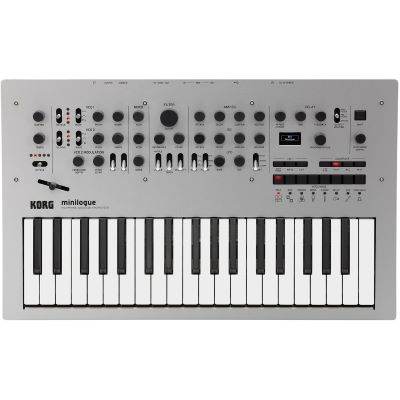
Direct controls for oscillator, filter, envelope and LFO make the signal path visible. A polyphonic synth such as the Korg minilogue is therefore a very clear introduction to subtractive sound design.
A synthesizer is more than a keyboard with unusual sounds: you can shape a sound yourself from the oscillator through the filter, envelope and modulation. You do not need to understand every synthesis method before buying your first instrument. Much more important is a synthesizer whose controls encourage experimentation and whose concept matches the kind of music you want to make.
For a first synthesizer, a clear workflow is often more useful than maximum technical depth. Decide whether you want to learn classic synthesis, play chords, program bass lines or build electronic patterns as quickly as possible.
Direct controls for oscillator, filter, envelope and LFO make the signal path visible. A polyphonic synth such as the Korg minilogue is therefore a very clear introduction to subtractive sound design.
MicroFreak, MiniFreak and wavetable synthesizers provide several oscillator models and flexible modulation. They are ideal if you want to explore classic and experimental sounds in one instrument.
Instruments such as Bass Station II or Monologue play one voice at a time. This deliberate limitation makes bass lines and lead sounds particularly direct and lets you concentrate on one sound at a time.
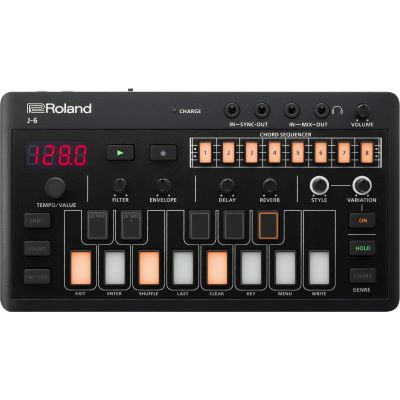
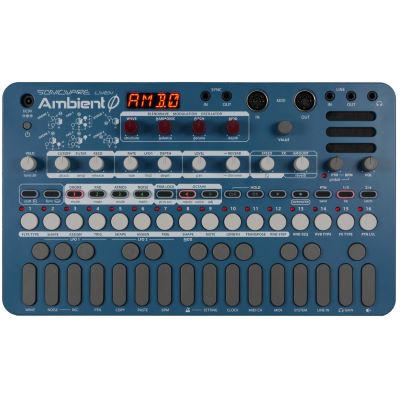
Roland J-6, Sonicware LIVEN and compact instruments such as the Korg Volca series combine sound generation with pattern-oriented work. This is a practical route for spontaneous electronic ideas without a large studio setup.
A simplified classic signal path can be written as: Oscillator → Filter → Amplifier → Effects / Output
An oscillator initially generates a waveform and pitch. Sawtooth, square and triangle waves contain different harmonic structures. Digital synthesizers can extend this idea with wavetables, FM, samples and other algorithms.
A low-pass filter lets lower frequencies pass and increasingly reduces frequencies above the selected cutoff point. Resonance emphasises the area around that point. These two controls alone can dramatically change a static oscillator sound.
ADSR stands for Attack, Decay, Sustain and Release. These parameters can determine whether a sound starts immediately or fades in, what happens after the initial attack and how long the note continues after you release the key.
A Low Frequency Oscillator is normally used to modulate another parameter rather than being heard directly. Applied to pitch it can create vibrato, to volume tremolo and to filter cutoff a repeating timbral movement.
In simple terms, modulation means that one parameter automatically changes another. Envelopes, LFOs, velocity, the modulation wheel and aftertouch can function as modulation sources.
Once you understand the relationship between a modulation source and destination, more complex modulation matrices become much easier to understand.
The synthesis method influences possibilities and workflow, but it does not automatically determine quality. For beginners, an understandable interface is often more important than whether an oscillator itself is generated in analog or digital form.
| Concept | Typical Character | Strength for Learning | Examples |
|---|---|---|---|
| Analog | Classic oscillator and filter architecture | Signal path is often easy to follow directly | minilogue, Monologue, Bass Station II |
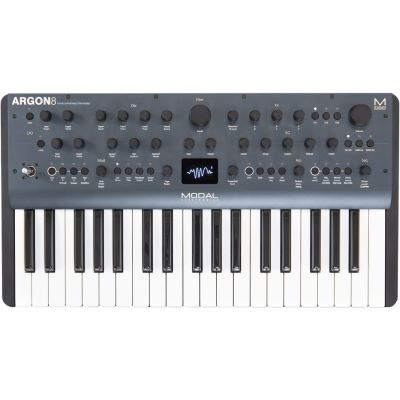
| Digital | Wavetables, modeling and many other methods | Large tonal range | Argon8, Roland J-6 |
| Hybrid | Combines digital and analog sections | Several sound worlds in one instrument | MicroFreak, MiniFreak |
| Semi-Modular | Signal path can additionally be patched | Deeper introduction to routing and CV | MiniBrute 2, Grandmother, MS-20 Mini |
Only one note can sound at a time. This works extremely well for bass lines, lead sounds, sequences and classic acid or synth-bass parts.
Several pitches can sound simultaneously but share certain parts of the sound-shaping architecture. The behaviour therefore differs from true independent polyphonic voices.
Several voices allow chords, pads and polyphonic melodies. Four voices are enough for simple chords, while six, eight or more voices provide more room for complex pads and longer releases.
Particularly straightforward as a first hardware synth: connect it, add headphones or speakers and start playing immediately. No additional controller is required for normal keyboard playing.
A desktop synthesizer has no traditional piano-style keyboard. For melodic playing, you will normally use a MIDI keyboard, sequencer or DAW as the control source.
If beats, several tracks and patterns are more important than learning one individual synthesizer architecture, a groove box may be the better starting point.
If you want to arrange complete songs using many instrument sounds rather than primarily building sounds from scratch, a workstation provides a different and more comprehensive concept.
A step sequencer stores notes and, on many synthesizers, parameter movements as well. You can program a bass line first and then manipulate the filter or modulation in real time while the pattern continues to play.
An arpeggiator turns held notes or chords into a repeating pattern. Especially at the beginning, this quickly creates a musical context in which changes to the filter and envelope become immediately audible.
There is no reason to avoid factory sounds. Select a preset and change only one section at a time. Afterwards, an empty Init sound is especially useful for building a bass, lead or pad step by step.
The actual synthesizer sound leaves the instrument through its audio output and can be routed to an audio interface, mixer, active speaker or amplifier.
MIDI carries performance and control information such as notes, velocity and controller data. MIDI itself is not the audible audio signal.
Many current synthesizers use USB to send MIDI to a computer. Some instruments additionally provide USB audio. This needs to be checked separately for the specific model.
Analog control signals can connect compatible synthesizers, modular systems and sequencers. They are useful for expanding a hardware setup but are not essential for a first standalone synthesizer.
Step sequencers, direct filter access and compact bass- and lead-oriented synthesizers make spontaneous electronic patterns especially easy to create.
Polyphony, presets, splits, performance functions and a playable keyboard become more important than extreme modularity when the instrument has to cover several roles inside a band.
More voices, complex modulation and effects are useful for slowly developing pads, drones and evolving atmospheric textures.
MicroFreak, semi-modular instruments and modular systems encourage you to move beyond conventional signal paths and create unusual modulation and routing combinations.
These five examples deliberately represent different workflows: direct analog synthesis, hybrid sound design, polyphonic wavetable synthesis, compact sequencing and layered ambient production.
The selection is grouped by task. Desktop synthesizers and MIDI keyboards are deliberately listed separately because a synthesizer module without its own keyboard often requires an additional control source for traditional playing.
The simplest route to quiet sound design. Check the connector size and headphone output of the synthesizer before buying.
Useful for desktop modules without their own keys. Check whether both devices can communicate via DIN MIDI, a suitable USB-host connection or another compatible route.
If you want to record the synthesizer into a computer, an audio interface connects its audio outputs with your recording software unless the synth itself provides suitable USB-audio functionality.
Keyboard synthesizers need a stable workspace. Suitable audio cables and, where necessary, MIDI cables complete the signal and control paths.
Presets are useful, but regularly change the filter, envelope and modulation yourself. This is how selecting a sound becomes actual sound design.
A large modular system can be fascinating, but a clear signal path usually teaches the fundamental principles faster.
A MIDI connection normally carries no audible audio track. If you want to record the synth, the audio signal path has to be planned as well.
Anyone planning to play pads and chords will quickly encounter the deliberate limitations of a purely monophonic synthesizer.
Start on several instruments with the simplest sound you can create. Change only the oscillator waveform, filter cutoff, attack and release. If these steps are immediately understandable and make you want to keep experimenting, that operating concept is probably a better match than an instrument whose specification list is impressive only on paper.
Discover compact sound modules without a traditional keyboard for existing MIDI and studio setups.
Combine beats, bass, melodies and patterns in a standalone production instrument.
Explore extensive sound libraries, sequencing and arrangement tools for complete productions.
Play desktop synthesizers and virtual instruments with suitable keyboards, pads and controllers.
For a first synthesizer, a clear signal path and an interface with direct access are particularly valuable. Oscillator, filter, envelope and LFO form a foundation that can be transferred to many analog, digital and hybrid instruments. If you want to play chords and pads, pay attention to sufficient polyphony; for bass and lead, a monophonic synthesizer can be the more focused choice.
Also decide whether you need an integrated keyboard. A desktop synthesizer saves space but normally requires a MIDI controller for conventional playing. Sequencers and arpeggiators help you build patterns quickly, while audio, MIDI, USB and optionally CV connections determine how the setup can expand later. This creates a synthesizer system that can grow from your first self-programmed sound into a complete studio or live rig.
From musical instruments and home-studio equipment to DJ and event technology, find further step-by-step buying help in the central Musikhaus Korn guide.